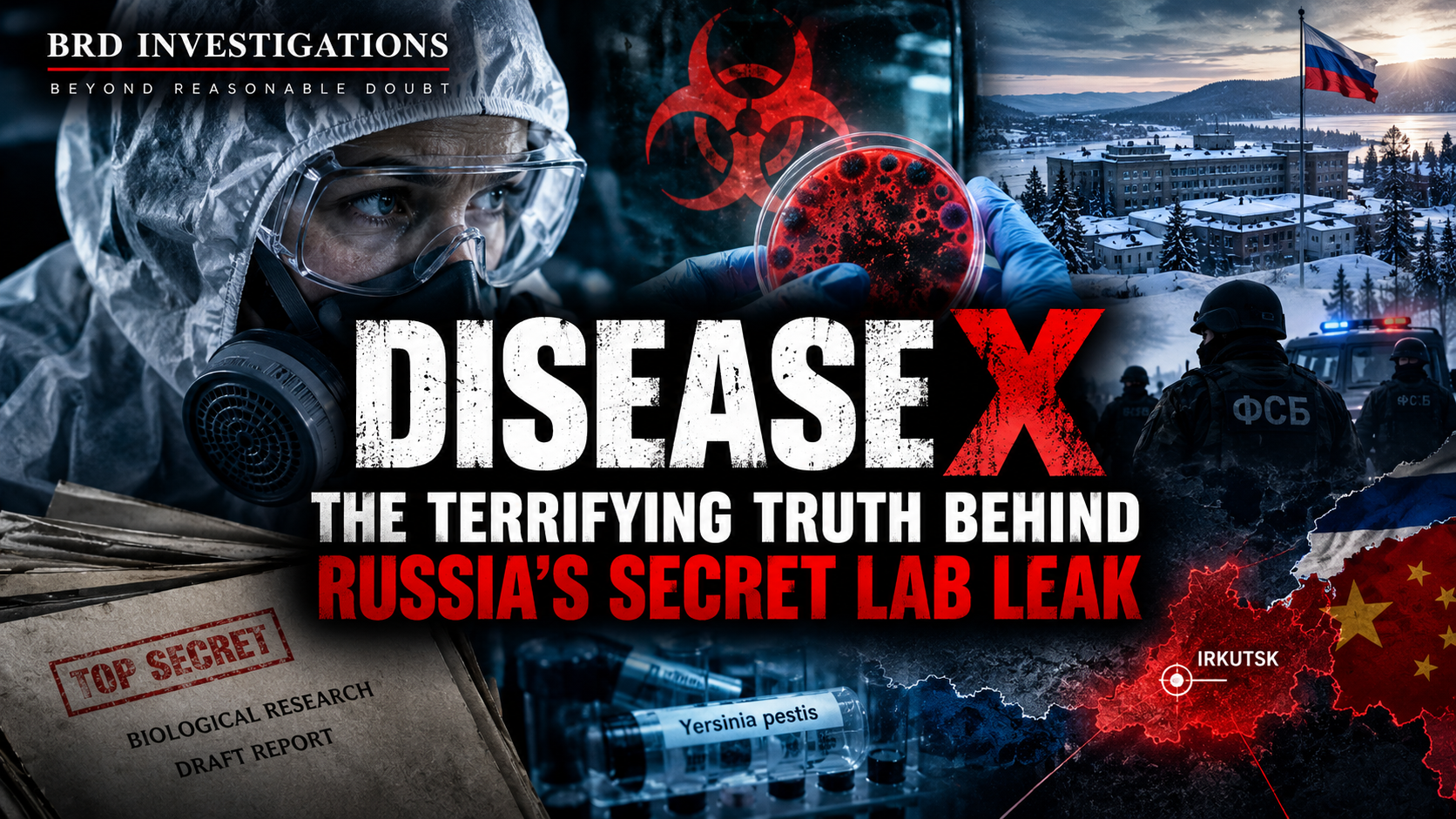
Disease X: The Terrifying Truth Behind Russia's Secret Lab Leak
Disease X: The Terrifying Truth Behind Russia’s Secret Lab Leak
A young scientist dies in Siberia after an alleged bioweapon pathogen exposure. Weeks earlier, Russian and Chinese military specialists rehearsed this exact scenario. Now, a state-directed cover-up is in full swing.
By Our Special Investigations Desk in Irkutsk
In the quiet, suburban outskirts of Irkutsk, a two-storey brick apartment building was disinfected three times in five days by hazmat teams wearing full protective gear and gas masks. When terrified neighbours asked why their stairwell was filled with acrid chemical fumes, one worker knocked on a door, asked for water to mix her solution, and lied directly to their faces: "It’s for cockroaches".
In reality, there were no cockroaches. The building was the home of Darya Shipilova, a 28-year-old medical biochemist who worked at the state-run Irkutsk Anti-Plague Research Institute of Siberia and the Far East. Hours earlier, Shipilova had died overnight on 2 October 2026 inside an isolation ward at Shelekhov District Hospital, her lungs destroyed by what doctors off-the-record confirmed was pneumonic plague Pneumonic Plague: A severe lung infection caused by the bacterium Yersinia pestis. It is the most virulent form of plague and spreads directly from person to person through airborne respiratory droplets. —the rarest, most lethal, and most contagious form of the Black Death.
What followed was an extraordinary campaign of state censorship, Kremlin denials, and military-backed containment that has sent shockwaves from Moscow to Washington and London. But the most chilling detail of all is not the leak itself—it is what happened just five weeks before Darya Shipilova fell ill.
In late August 2026, over 300 Chinese and Russian military and civilian specialists—including the director of Shipilova’s own institute and officers from the People’s Liberation Army (PLA) Northern Theater Command—assembled in the Chinese border city of Fuyuan. The title of their exercise? A cross-border response to imported pneumonic plague and a newly emergent, unknown pathogen designated "Disease X" Disease X: A World Health Organisation placeholder term representing the knowledge that a serious international epidemic could be caused by a pathogen currently unknown to cause human disease. .
The Victim: An Honours Biochemist Who Feared Contagion
Far from being an inexperienced lab assistant, Darya Shipilova was an exceptionally accomplished scientist. She graduated with honours in medical biochemistry from Irkutsk State Medical University in 2022 before completing a prestigious residency in clinical laboratory diagnostics. In March 2026, she presented cutting-edge research at the All-Russian Congress on Infectious Diseases in Moscow titled "Studying the Antibiotic Susceptibility of Yersinia pestis from Natural Plague Foci in Siberia".
Colleagues described Shipilova as obsessively cautious, noting she constantly disinfected her hands even outside the laboratory because she was deeply anxious about infecting others if a safety breach ever occurred.
On 25 September 2026, an incident took place inside the high-containment facility. Unofficial reports leaking from regional media indicate that Shipilova accidentally smashed a glass container or test tube containing live, high-potency Yersinia pestis Yersinia pestis: The highly virulent bacterial agent that causes plague, historically responsible for devastating global pandemics. bacteria while collecting samples. Within days, she developed cold symptoms and facial swelling at work. By 29 September, her condition had deteriorated into acute respiratory distress, and she was rushed to Shelekhov District Hospital—a facility previously used for COVID-19 isolation. Put on a mechanical ventilator, she died two days later.
Important Warning: The Kremlin Cover-Up
The moment Shipilova died, Russia’s federal health surveillance agency, Rospotrebnadzor Rospotrebnadzor: Russia's federal executive body responsible for surveillance and control in the field of consumer rights protection and human wellbeing. , triggered a massive suppression operation. Official state claims of "stability" were immediately contradicted by a trail of panicked, scrubbed communications:
- Edited Regional Declarations: The Governor of Buryatia explicitly confirmed a woman had "died of plague" online, before mysteriously editing the post hours later to state she "possibly" died of plague.
- Deleted Municipal Warnings: An urgent public notice from the Baikalsk administration warning residents of a "confirmed case of plague" was scrubbed from the internet in less than two hours.
- Scrubbed News Reports: State broadcasters and pro-Kremlin newspapers deleted all articles referencing pathogen spread or criminal negligence investigations into the institute.
- Gagged Medical Staff: Irkutsk physicians were strictly ordered to omit the word "plague" from all medical certificates, despite discussing the pneumonic plague diagnosis openly among themselves.
Anna Popova, the Kremlin’s chief sanitary doctor, flew 2,500 miles directly from Moscow to Irkutsk on 2 October to take personal command. Officially, Rospotrebnadzor declared that Shipilova had died of "pneumonia of unknown aetiology" and claimed post-mortem testing revealed no pathogens connected to her work.
Prominent Russian epidemiologist Dr Mikhail Favorov publicly mocked the Kremlin’s narrative: "The story about a broken test tube is simply laughable, since specialists work in protective suits inside biosafety cabinets. A large-scale cover-up of the facts from the public is currently underway."
Extreme Containment: FSB Escorts and Sleeping on Floors
Despite Kremlin assertions that there was no danger, local authorities instituted draconian lockdown measures:
- Institute Staff Imprisoned: Over 60 researchers and staff were locked inside their laboratory building for three days. Employees were swabbed twice daily and forced to sleep on office chairs or winter coats.
- FSB Ambulance Escorts: Up to 197 individuals who had contact with Shipilova were quarantined. Ambulances transporting these contacts were escorted by armed officers from the FSB FSB (Federal Security Service): The principal security agency of Russia, tasked with counter-intelligence, internal, and border security. .
- Five Hospitals Closed: Multiple medical facilities across Irkutsk were closed under three-week quarantines.
- Maternity "Plague Questionnaires": Pregnant women arriving at the Irkutsk City Perinatal Center were handed an official "Checklist for a suspected particularly dangerous infection: 'Plague'".
- Pharmacy Panic: Fights broke out at pharmacy counters as panicked residents cleared out all available stocks of broad-spectrum antibiotics.
The Sino-Russian "Disease X" Drills: A Coincidence Too Far?
The timing of the Irkutsk incident has drawn intense scrutiny from intelligence analysts in London and Washington due to its connection to Sino-Russian biosecurity programmes. From 24 to 27 August 2026, over 300 Chinese and Russian personnel convened in Fuyuan, Heilongjiang, for a massive joint exercise focusing on three precise scenarios:
- Imported Pneumonic Plague: Simulating cross-border joint response and containment of airborne plague.
- Tick-Borne "Disease X": Practicing field sampling and metagenomic sequencing to identify unknown, highly lethal pathogens.
- Emergency Sanitation: Deploying mobile containment labs.
Standing on the platform in Fuyuan as a key speaker was Sergey Balakhonov—the Director of the Irkutsk Anti-Plague Research Institute, where Shipilova would meet her death five weeks later. Balakhonov addressed the assembly alongside senior officers from the PLA Northern Theater Command Disease Control Center.
Academic records reveal that researchers at the Irkutsk institute have previously co-authored molecular genetic studies on Yersinia pestis strains alongside scientists from Beijing's State Key Laboratory of Pathogen and Biosecurity—a facility operated directly under the PLA Academy of Military Medical Sciences.
On 29 September 2026—the exact day Shipilova was hospitalised on a ventilator—the 26th PRC-Russia Health Cooperation Subcommittee met in Beijing. Official readouts omitted any mention of the emergency unfolding in Siberia. Up to six direct flights per day continued to operate between Irkutsk and major Chinese travel hubs without a single health advisory.
Biological Warfare Legacy: Cold War Chimeras and "Problem 5"
To understand why a lab leak in Irkutsk triggers such global panic, one must look at the facility’s history. During the Cold War, the Irkutsk Anti-Plague Institute operated under the Soviet Ministry of Health’s secret "Problem 5" biological weapons defence framework. Under the cover of public health, the Soviet bioweapons agency Biopreparat Biopreparat: The Soviet Union's major biological warfare agency established in the 1970s, which oversaw a massive network of secret laboratories and weaponised pathogens. conducted genetic engineering on Yersinia pestis.
Soviet scientists successfully created chimeric plague strains by splicing myelin toxin genes directly into the bacteria. The result was horrific: when infected patients were treated with standard antibiotics, the dying bacteria released massive waves of myelin toxins, causing full-body paralysis or immediate death.
While naturally occurring pneumonic plague remains treatable with standard broad-spectrum antibiotics (such as doxycycline or ciprofloxacin) if administered within 24 hours of exposure, an engineered or antibiotic-resistant strain would completely bypass modern medicine.
Global Impact: High Alert Across Western Capitals
The event has placed Western national security agencies on high alert:
- United States: US Secretary of State Marco Rubio confirmed Washington was tracking the Siberian outbreak "hour by hour". US President Donald Trump stated the US was ready to assist Russia, noting: "They call it pneumonia... those microbes have gotten stronger and smarter". Local Siberian officials snidely rejected the offer, stating: "We can handle this ourselves".
- Central Asia: Neighbouring states including Kyrgyzstan and Kazakhstan immediately placed all border sanitary checkpoints on heightened alert, enforcing temperature screening on all incoming transport from Russia.
- UK and European Response: Both the World Health Organisation (WHO) and the European Centre for Disease Prevention and Control (ECDC) stated they were monitoring the situation closely. Experts from the London School of Hygiene & Tropical Medicine emphasised that while wild-type plague risk remains low if contained, full international transparency from Moscow is urgently required.
As Darya Shipilova’s family remains trapped in hospital isolation, her body has still not been released for burial. The official Kremlin certificate reads "pneumonia". But across the world, biosecurity experts are asking a far darker question: what were Russia and China really testing in Fuyuan, and what truly escaped from the laboratory in Irkutsk?


Comments
Post a Comment