Dr Ravi Jayaram Exposed: The Shocking Truth Behind His Courtroom Drama
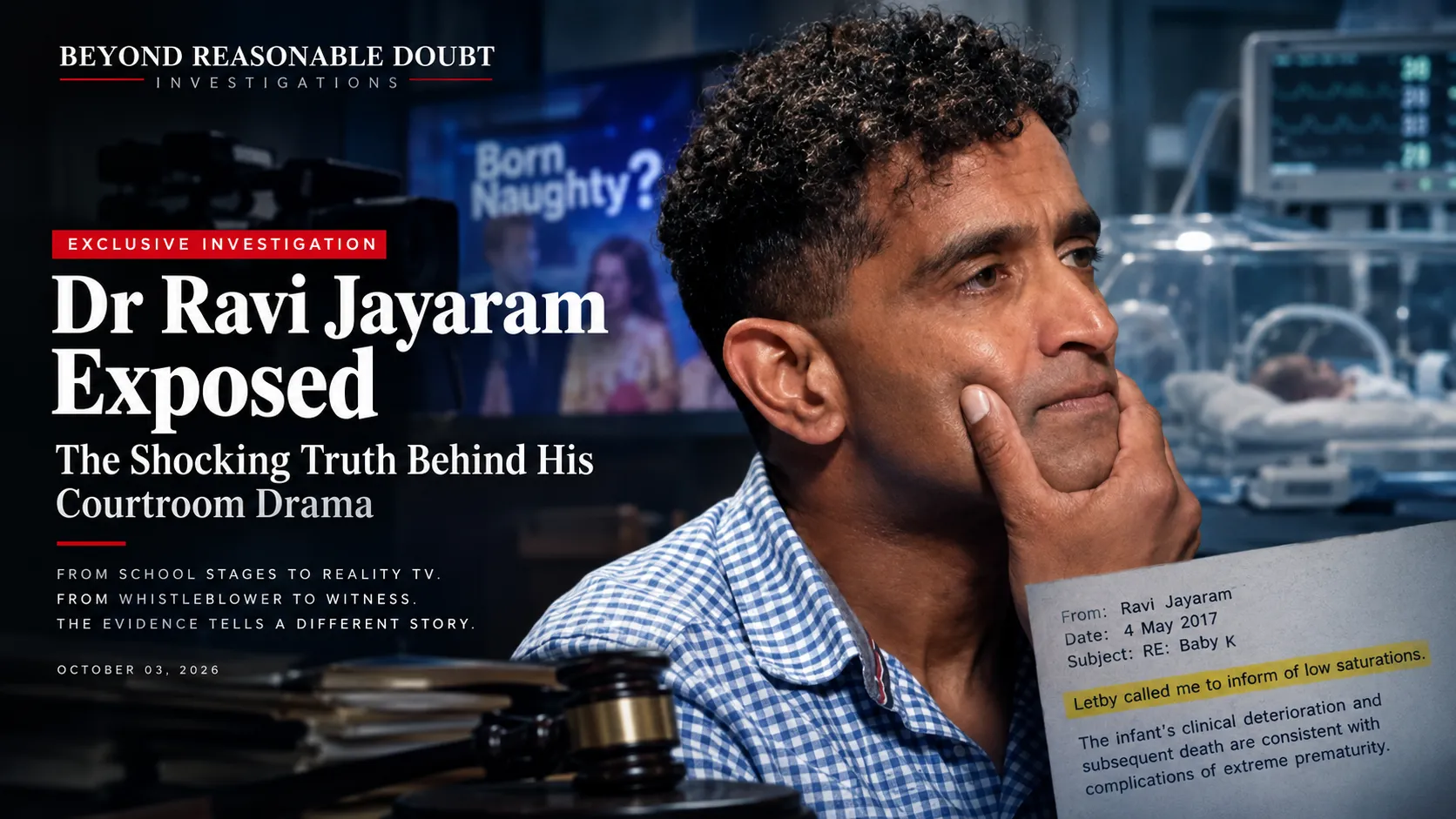
Dr Ravi Jayaram Exposed: The Flawed Witness & Courtroom Drama
Dr Ravi Jayaram Exposed: The Shocking Truth Behind His Courtroom Drama
Dr Ravi Jayaram has been heavily stylised within the British mainstream media narrative as a courageous, relentless whistleblower who single-handedly fought a lethargic hospital administration to stop a serial killer. However, an exhaustive forensic examination of his professional history, his pursuit of television fame, and a bombshell internal email reveals a deeply concerning profile. Far from the flawless hero presented to the public, the evidence points to a practitioner whose penchant for the spotlight and performative storytelling may have fundamentally overwritten clinical reality.
By The BRD Investigations Team
At BRD Investigations, our mission is to examine the evidence behind high-profile legal verdicts rather than accepting state-sanctioned narratives at face value. In complex medical prosecutions, the credibility of key eyewitnesses is paramount. When a conviction hinges almost entirely on the memory and interpretation of a single consultant paediatrician, every aspect of that witness’s testimony must withstand rigorous scrutiny. In the trial of neonatal nurse Lucy Letby, Dr Ravi Jayaram served as the central pillar of the prosecution's direct evidence. Yet, when his sworn statements in court are cross-referenced against contemporaneous hospital records, the narrative of heroics quickly disintegrates into a series of irreconcilable contradictions.
1. From Private School Stages to Reality TV
To understand Dr Jayaram's demeanour in the witness box, one must examine his formative years and lifelong affinity for public performance. Educated at The King's School in Chester—an elite independent day school—historical archives reveal a young man deeply drawn to public attention, theatricality, and competitive presentation:
- May 1981: He demonstrated a strong competitive drive early on, winning the Victor Ludorum Trophy with his Junior 14 rowing crew, as recorded in the Cheshire Observer on 8 May 1981.
- March 1984: His desire to command an audience was formalised when he represented his school in the English Speaking Union Public Speaking competition, earning a third-place finish, as reported in both the Cheshire Observer and the Chester Chronicle.
- April 1984: He was an active participant in regional sixth-form networking, documented as a key member of the Chester EUS Sixth Form Link.
- December 1984: A photograph published in the Cheshire Observer on 28 December 1984 captures a young Jayaram on stage reflecting on the "hollow crown" during a school production of Shakespeare's Richard II.
This early passion for theatre never dissipated. Throughout his medical career, Dr Jayaram has openly described himself as a "wannabe rockstar" who actively enjoys the public spotlight. By 2015—the exact timeframe during which the alleged collapses occurred at the Countess of Chester Hospital—Dr Jayaram was dividing his professional time between his clinical duties on the neonatal unit and national television studios, co-hosting the Channel 4 reality series Born Naughty?.
2. The Ethics of Entertainment vs Paediatric Safeguarding
The production of Born Naughty? raised significant ethical alarms within the medical community. The television programme featured Dr Jayaram assessing children with severe behavioural, communication, and neurological issues on camera for entertainment purposes. Media analysts and child welfare advocates strongly criticised the format, arguing that it exploited vulnerable children during their formative years for commercial ratings.
The broadcast format exposed these children to public commentary and Internet trolling, creating a dangerous overlap between clinical objectivity and reality television. Critics argued that a consultant paediatrician participating in the commercial sensationalisation of childhood distress demonstrated a concerning lapse in professional boundary setting—a trait that would later re-emerge during his high-profile media appearances following the Letby trial.
3. The Bombshell Contradiction: Baby K and the Courtroom Narrative
The most critical element of Dr Jayaram's involvement in the prosecution of Lucy Letby relates to the case of "Baby K", a highly premature infant born at 25 weeks' gestation in February 2016. Dr Jayaram was the only medical professional in the entire multi-year investigation who claimed to have personally walked in on Letby in the middle of an alleged physical attack.
Giving evidence under oath at Manchester Crown Court in 2023, Dr Jayaram delivered a dramatic and memorable account to the jury:
- He swore that he walked into Nursery 1 and caught Letby standing idly over Baby K’s incubator while the infant's blood oxygen saturation levels were dropping dangerously low.
- He testified under oath that Letby was doing "absolutely nothing" to assist the dying infant, making no move to evaluate the breathing tube or call for help.
- He heavily implied to the court that Letby had intentionally silenced the equipment alarms, claiming that a spontaneous dislodgement of the endotracheal tube in a sedated infant was "statistically near-impossible" and that deliberate tampering was the only logical explanation.
The 2017 Internal Email: Narrative Shattered
This dramatic courtroom testimony was fundamentally undermined by the discovery of an internal, contemporaneous hospital email written by Dr Jayaram himself on 4 May 2017. In this official written account, drafted long before police involvement, Dr Jayaram explicitly recorded that Letby had actively and correctly called him to the nursery to alert him that the infant's oxygen levels were falling. The 2017 document contained zero mention of catching Letby "red-handed," zero mention of silenced alarms, and attributed the clinical deterioration entirely to the known complications of extreme 25-week prematurity.
This irreconcilable conflict between a contemporaneous medical record written in 2017 and a highly dramatic, theatrical recollection delivered under oath in 2023 strikes at the very heart of the verdict's safety. In a court of law, contemporaneous written records are legally considered far more reliable than memories recalled years later following extensive media coverage and police interviews.
4. Legal Implications: Perjury, Negligence, and GMC Standards
The paradox between Dr Jayaram’s contemporaneous records and his trial testimony carries severe legal and ethical ramifications:
Perjury & Evidentiary Rules
Under the Perjury Act 1911, giving false evidence material to the proceedings while under oath is a severe criminal offence. If a key witness significantly alters or embellishes factual events to fit a narrative of guilt, the integrity of the entire judicial process is compromised. The stark disparity between the 2017 email and the 2023 trial testimony provides compelling grounds for an appellate review regarding witness reliability.
Gross Professional Negligence
If Dr Jayaram's courtroom recollection was entirely accurate—that he personally caught a nurse in the act of attempting to murder a 25-week-old infant by dislodging her breathing tube—his subsequent professional conduct raises profound safeguarding questions. Hospital logs confirm that following this alleged incident, Dr Jayaram did not immediately call the police, did not suspend the nurse, and allowed her to continue working unsupervised with vulnerable infants for months. Under GMC General Medical Council (GMC): The public body that maintains the official register of medical practitioners within the United Kingdom and sets the statutory standards for medical ethics and safeguarding. guidelines, failing to immediately escalate a known, direct threat to patient life constitutes gross professional misconduct.
Systemic Deflection of Hospital Failures
Independent reviews into the Countess of Chester Hospital, including the 2016 Royal College of Paediatrics and Child Health (RCPCH) report, documented widespread clinical leadership failures, sub-standard transport protocols, and severe understaffing. By focusing public and judicial attention entirely onto an alleged insider threat, senior clinicians—including Dr Jayaram—effectively shifted the narrative away from broader systemic and clinical management failures on the unit.
5. Conclusion: A Flawed Narrator in a Systemic Crisis
Dr Ravi Jayaram stands as a central, yet deeply conflicted, figure in Britain's most controversial modern trial. The documented evidence reveals a practitioner who combined a lifelong affinity for performance and media attention with an institutional environment under immense operational stress. When narrative replacing objective documentation is presented as sworn evidence in a capital trial, the danger of a miscarriage of justice becomes acute.
BRD Investigations remains committed to documenting the unredacted facts of this landmark case. We invite our readers to review the trial transcripts, scrutinise the clinical records, and demand complete transparency from the ongoing public inquiry into the NHS and the British legal system.
Help us continue this vital work. Subscribe to BRD Investigations, watch our full forensic video breakdown above, and share this article to ensure the truth is heard.


Comments
Post a Comment