The Lucy Letby Case Exposed: State-Funded Media, Flawed Science & CCRC Bias
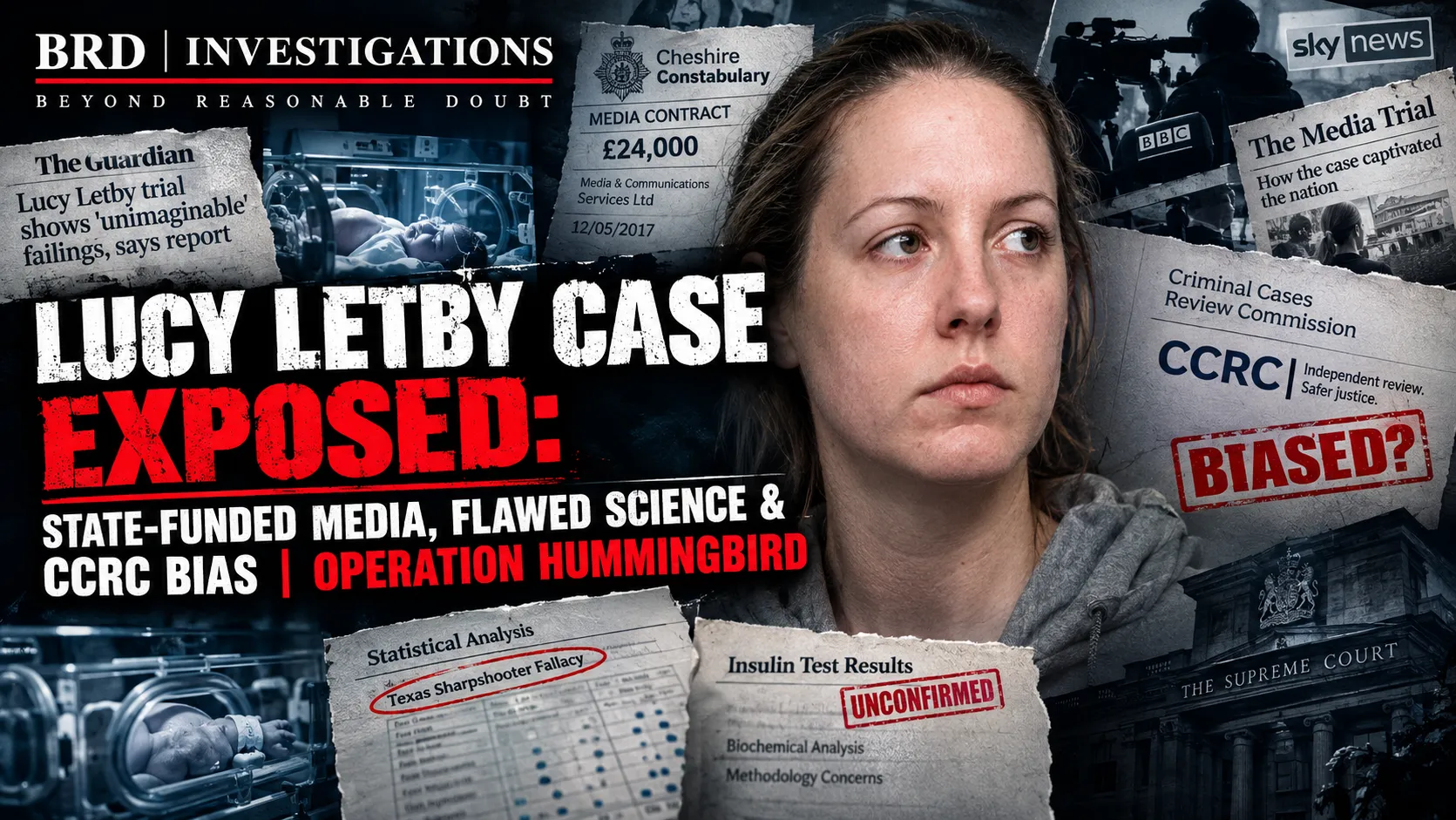
The State-Sponsored Verdict: How Police Funded the Media to Convict Lucy Letby
The State-Sponsored Verdict: Exposing the Investigation Behind the Lucy Letby Convictions
Was the conviction of neonatal nurse Lucy Letby a triumph of modern forensic science, or the result of a meticulously engineered, state-funded public relations campaign? The official narrative presents a cold, calculating killer. The suppressed truth, however, exposes profound structural vulnerabilities, statistical manipulation, and unprecedented financial conflicts of interest that threaten the very integrity of the British justice system.
By The BRD Investigations Team
At BRD Investigations, we refuse to accept the sanitised, highly curated narratives spoon-fed to the public by state prosecuting authorities. The criminal justice system consistently prioritises protecting its own operational investments and institutional reputation over acknowledging objective truth. The prosecution of Lucy Letby at the Countess of Chester Hospital stands as one of the most consequential, and longest-running, criminal cases in modern UK history. Yet, a rigorous, independent forensic examination of Cheshire Constabulary’s "Operation Hummingbird" reveals a police operation that appeared to prioritise narrative engineering over objective forensic inquiry.
From actively funding the journalists covering the trial to bypassing mandatory forensic standards, the investigation demonstrates a catastrophic breakdown in due process. By synthesising these procedural, forensic, and ethical failures, it becomes clear that state-sponsored media narratives and acute confirmation bias provide substantive legal grounds to argue that the jury pool was hopelessly prejudiced, thereby denying the defendant a fair trial.
The Forgotten Context: Systemic Collapse at the Countess of Chester
Before examining the specific forensic failings of the prosecution, one must understand the environment in which these tragic neonatal deaths occurred. The Crown Prosecution Service (CPS) painted a picture of a well-functioning ward that experienced a sudden, inexplicable spike in mortality solely because a malicious actor was present. This narrative ignores a wealth of documented, systemic institutional failures.
During the exact period of the alleged offences (2015–2016), the Countess of Chester’s neonatal unit was suffering from critical operational stress. An independent review by the Royal College of Paediatrics and Child Health (RCPCH) highlighted severe understaffing and an over-reliance on agency nurses. Furthermore, the ward was plagued by acute plumbing failures; staff reported raw sewage backing up into the sinks within the intensive care rooms. This highly unsanitary environment coincided with an outbreak of Pseudomonas aeruginosa, a lethal bacterium specifically dangerous to premature, immunocompromised infants. Instead of thoroughly investigating these catastrophic environmental hazards as the primary cause of the mortality spike, hospital management and police investigators quickly narrowed their focus onto a single scapegoat, effectively shielding the NHS trust from corporate manslaughter liabilities.
The Financial Architecture of Prejudice: The £24,000 Question
One of the most legally and ethically contentious elements of Operation Hummingbird is the direct financial relationship between Cheshire Constabulary and the media entities actively covering the investigation and subsequent trial. Under the strict parameters of the Contempt of Court Act 1981, the media is legally obligated to remain impartial during active proceedings to prevent prejudicing a jury.
Initial Freedom of Information (FOI) requests probing these financial ties were met with institutional resistance; Cheshire Police originally claimed that "no information was held" regarding payments to Media Factory Limited. However, sustained transparency disclosures contradicted this denial, uncovering that the constabulary had made a series of payments totalling nearly £24,000 to the media firm. This production company is owned by Caroline Cheetham, a prominent broadcast journalist and the co-host of a dominant Daily Mail podcast that provided exhaustive, daily coverage of the Letby trial to millions of listeners.
These payments were drawn directly from the dedicated Operation Hummingbird investigation budget. The timing is of critical legal significance: £3,950 was paid in March 2022 immediately preceding the trial; £4,100 was processed for "Publicity" in October 2022 just days after the jury was seated; and another £3,950 was paid for "Publicity" in April 2023 concurrently with the defence presenting its case.
By directly financing the creators of a podcast that consistently framed the prosecution's circumstantial case as overwhelming, Cheshire Constabulary effectively funded a state-sponsored campaign to shape the public narrative. This subverts the foundational principle of an independent press acting as a critical check on state power.
A Subversion of Journalistic Independence
When the investigation's own operational budget funds the commentators disseminating the trial's daily events to the public, the demarcation between objective journalism and state-funded public relations dissolves entirely. This orchestration of the narrative of guilt long before the jury retired raises profound questions about the contamination of the jury pool and the safety of the convictions.
Statistical Fallacies: The Texas Sharpshooter
The prosecution's case lacked traditional forensic evidence of murder; there were no eyewitnesses, no CCTV footage of any attacks, and no direct physical evidence linking Letby to the malicious administration of substances or air. Instead, the Crown constructed its case upon circumstantial association, anchored by a single, highly persuasive visual exhibit: a staff shift roster chart.
This grid plotted 25 "suspicious" neonatal collapses against the specific nurses on duty, presenting Letby visually as the sole common denominator. However, independent statistical experts, including the prestigious Royal Statistical Society, have rigorously condemned this methodology as a textbook example of the Texas Sharpshooter Fallacy Texas Sharpshooter Fallacy: A logical error deriving its name from a theoretical marksman who fires randomly at the side of a barn, paints a target around the tightest cluster of bullet holes, and then claims exceptional accuracy. .
The investigators retrospectively selected the 25 events specifically because Letby was present at them. Crucially, the police investigation systematically excluded between six and ten other neonatal deaths, as well as numerous non-fatal collapses, that occurred on the ward during the exact same cluster period when Letby was not on duty. By filtering the unit's data to hide the baseline morbidity rate, the prosecution created a meaningless tautology: Letby was present at all the events at which Letby was present. This is not proof of murder; it is proof of selective data harvesting.
The Insulin Evidence: A Biochemical Misinterpretation
The convictions for attempted murder by insulin poisoning were described by the prosecution and the media as the indisputable "smoking gun". The Crown alleged Letby maliciously injected synthetic insulin into intravenous neonatal feed bags, based entirely on hospital blood tests showing high insulin coupled with abnormally low C-peptide levels.
However, these tests were standard hospital immunoassays, which clinical laboratory guidelines and test manufacturers state clearly are presumptive, prone to severe cross-reactivity interference, and absolutely not definitive for criminal forensic purposes. The UK legal standard for proving exogenous (externally administered) insulin administration dictates that samples must be sent for secondary liquid chromatography-mass spectrometry (LC-MS). In a staggering investigative failure, detectives never ordered mass spectrometry confirmation, thereby bypassing established instructions from the Forensic Science Regulator.
Furthermore, peer-reviewed research by insulin experts, including Professor Geoff Chase, demonstrates that inverted insulin-to-C-peptide ratios are highly common in insulin-free, critically ill preterm infants. Premature neonates experiencing severe physiological stress naturally produce binding antibodies that act as a "storage medium" for insulin; when standard immunoassay tests strip this trapped insulin, it results in artificially inflated "sky-high" readings. This completely natural, documented biological phenomenon perfectly mimics the exact biochemical profile of exogenous poisoning that the prosecution relied upon.
The "Hired Gun": Dr. Dewi Evans
The medical foundation of the prosecution rested heavily on Dr. Dewi Evans, a retired paediatrician who proactively approached the police to volunteer his services. During the Letby trial, it emerged that Lord Justice Peter Jackson in the Court of Appeal had unequivocally condemned Dr. Evans's expert report in an unrelated case as entirely "worthless" and "partisan". When established medical textbook consensus on air embolism contradicted his theories regarding the collapses at the Countess of Chester, Dr. Evans simply dismissed the textbooks and posited novel, scientifically unproven mechanisms while under oath on the stand.
Institutional Bias and Article 6 ECHR Breaches
The confirmation bias that plagued the initial police investigation has deeply infected the institutional apparatus designed to review miscarriages of justice in the UK. Following the convictions, a 14-member international expert panel comprising neonatologists and statisticians concluded there was absolutely no medical evidence of murder, attributing the collapses to extreme prematurity and systemic hospital failures. Yet, when this comprehensive dossier was submitted to the Criminal Cases Review Commission (CCRC), the lead official tasked with reviewing the application, Shaun Edwards, was forced to step down in disgrace. He had posted publicly on LinkedIn, lavishly praising the very Cheshire Police detectives he was supposed to be impartially auditing.
This exposes a profound regulatory capture and sets the stage for a formidable legal challenge under Article 6 of the European Convention on Human Rights (the right to a fair trial). The central legal argument being mounted by advocates is that the jury pool was hopelessly prejudiced by the state's actions. In the landmark case of R v Taylor and Taylor (1993), the Court of Appeal quashed murder convictions precisely because sensationalist press coverage obliterated the presumption of innocence.
The Lucy Letby case escalates this legal precedent to a critical new threshold: the prejudicial media coverage was not merely organic sensationalism; it was directly subsidised, trained, and shaped by the prosecuting authority through £24,000 in operational budget payments. When the state financially supports the press to broadcast its preferred narrative during an active trial, the state is actively manufacturing the prejudice that destroys the fairness of the proceedings.
The convictions of Lucy Letby stand as a deeply troubling testament not to forensic certainty, but to the inherent dangers of state-sponsored narrative engineering. We must demand accountability and transparency from a justice system that appears to prioritise securing convictions and protecting NHS management over uncovering the truth.
We need your help to expose this systemic failure. Subscribe to BRD Investigations, watch our full forensic video breakdown at the top of this page, and share this evidence far and wide to demand a transparent public inquiry.


Comments
Post a Comment