Russell Brand Trial Unmasked: Shocking Court Evidence & Corporate Complicity
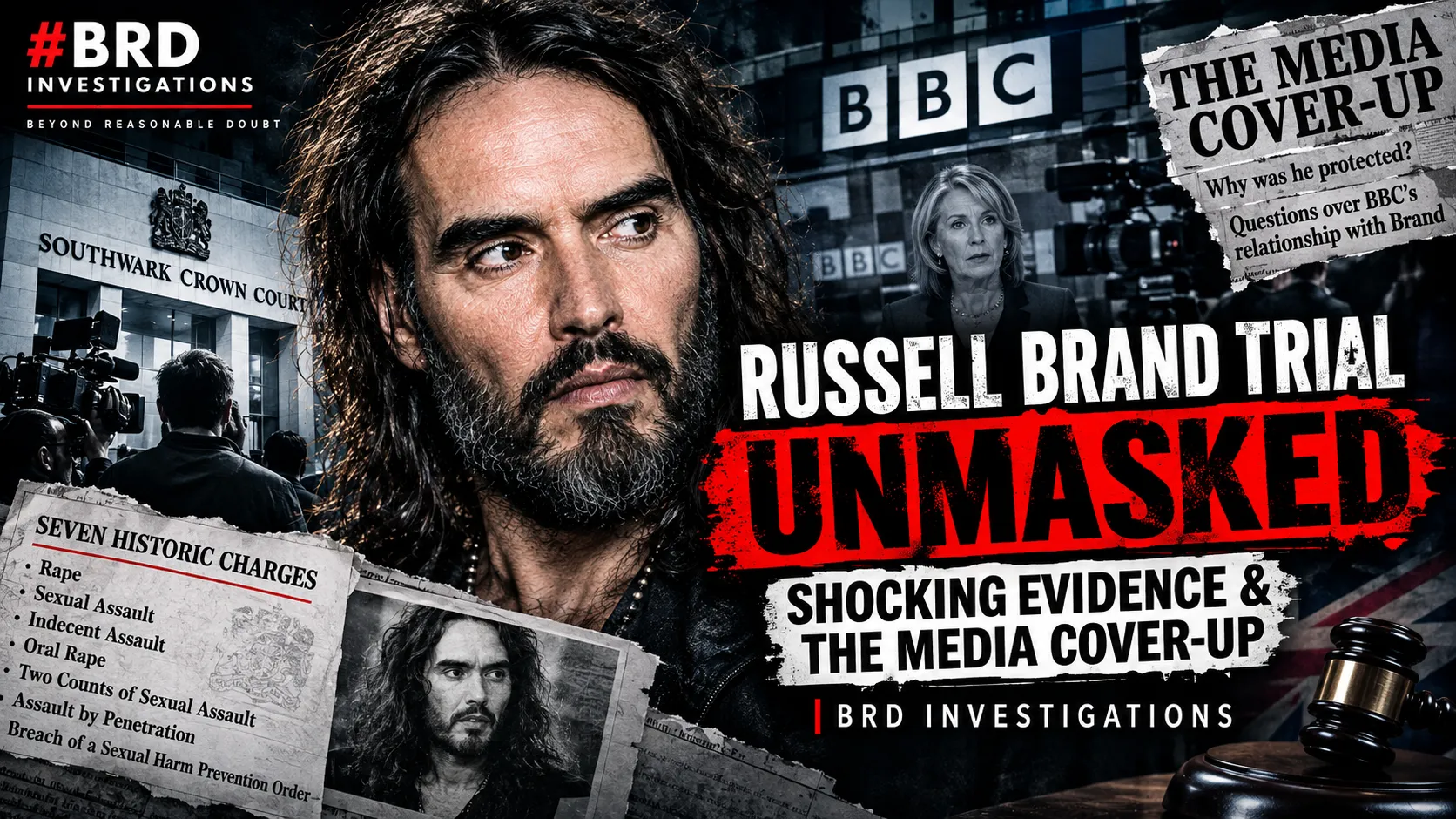
Russell Brand Trial UNMASKED: Shocking Evidence & The Media Cover-Up
Reckoning: The Russell Brand Trial and the Architecture of Enablement
A definitive BRD investigation into a decade of alleged predatory behaviour, systemic corporate complicity across British broadcasting, and the anatomy of a scandal that the UK media tried to bury.
By The BRD Investigations Team
1. Executive Summary & The High Court Reckoning
In October 2026, Russell Brand—once the undisputed, anarchic golden boy of British television and radio—walked up the stone steps of Southwark Crown Court to face a jury of twelve and High Court judge Mr Justice Joel Bennathan. Clad in a tailored grey suit, dark sunglasses, and a prominent silver crucifix resting against his chest, the 51-year-old comedian-turned-podcaster presented the highly curated image of a serene, born-again Christian. Yet, behind this quiet piety lies one of the most severe and systemic criminal indictments in the modern history of the UK entertainment industry.
Brand stands charged with seven historical sexual offences spanning a critical ten-year period from 1999 to 2009. This decade correlates precisely with his meteoric rise from an unpredictable alternative stand-up comic to a mainstream Hollywood lead and transatlantic celebrity. The indictment comprises three counts of rape, three counts of sexual assault, and one count of indecent assault relating to six separate complainants. Authorised by the Crown Prosecution Service (CPS) following an exhaustive and complex Metropolitan Police inquiry, the charges carry potential multi-year prison sentences. The CPS only authorises such charges when the "Full Code Test" is met—meaning prosecutors believe there is a realistic prospect of conviction based on the physical and testimonial evidence secured.
| Alleged Date | Location | Formal Legal Charge |
|---|---|---|
| Autumn 1999 | Bournemouth Hotel | Rape |
| 2001 | MTV Studios, Westminster | Indecent Assault |
| 2004 | Soho Restroom, London | Oral Rape |
| 2004 – 2005 | Radio Station, Westminster | Sexual Assault |
| 2004 – 2005 | Westminster Location | Sexual Assault |
| Feb – Mar 2009 | London Location | Rape |
| Aug – Dec 2009 | Channel 4 Production Set | Sexual Assault |
While Brand firmly maintains his innocence—pleading not guilty to all charges and asserting via his online channels that every sexual encounter in his life was "always, always entirely consensual"—prosecutors describe a "ruthless, calculated and manipulative" predator. The Crown's case rests not just on the alleged acts themselves, but on the assertion that Brand's actions were actively shielded for years by a corporate architecture terrified of losing its top revenue-generating star.
2. Unmasking the Archive: "Edgy Comedy" as a Smokescreen
To understand the mechanics of how Brand operated, our investigation demands an examination of a long pattern of extreme, boundary-pushing incidents. These were repeatedly dismissed by media executives and television commissioners as "rock-and-roll eccentricity" or "edgy comedy" rather than glaring red flags of deeply concerning behaviour. Long before his High Court trial, Brand’s early career was littered with dismissals, police arrests, and disturbing public stunts that tested the limits of institutional tolerance:
- May 2001 Piccadilly Arrest: During May Day anti-capitalist demonstrations in central London, Brand stripped completely naked at Piccadilly Circus by the statue of Eros and was arrested by Metropolitan Police officers. The incident was framed as performance art.
- 12 September 2001 MTV Firing: Just twenty-four hours after the devastating 9/11 terror attacks, Brand arrived at the MTV UK studios dressed in an Osama bin Laden costume—complete with a fake beard and flak jacket. Crucially, he bypassed security to bring his personal heroin and crack cocaine dealer into the studio, introducing him to pop star Kylie Minogue. MTV sacked him two days later, citing gross misconduct.
- 2002 XFM Sacking: Brand was dismissed from XFM radio after reading explicit, non-consensual pornographic material live on-air during a Sunday afternoon broadcast.
- 2008 Hoax 999 Police Call: During a live comedy performance at the Royal & Derngate theatre in Northampton, Brand dialled 999 from the stage, making a hoax emergency call to police claiming he had spotted a suspect wanted for local physical assaults.
- 2008 Rape Helpline Prank Call: In one of the most chilling precursors to his current charges, Brand broadcast prank calls made directly to a rape crisis support helpline during a live radio show. This triggered intense outrage from survivor advocacy groups, yet his career trajectory remained entirely unharmed by the controversy.
BRD Investigations posits that these public transgressions served a dual purpose: they built his lucrative "bad boy" brand, whilst simultaneously testing the boundaries of what he could get away with behind closed doors without facing institutional pushback.
3. Institutional Complicity: The Corporate Machinery of Silence
The core finding of the BRD Investigations analysis is that Brand did not operate in a vacuum. He was backed, funded, and protected by a 2000s British media culture dominated by hyper-sexualised "lad culture" magazines (such as Zoo, Nuts, and FHM). Furthermore, he benefited from a systemic phenomenon sociologists term himpathy Himpathy: The habitual tendency to forgive the transgressions of powerful or famous male figures while ignoring, diminishing, or actively silencing the harm done to female victims. —an ingrained media bias that prioritises male talent over female safety.
The Corporate Systemic Pipeline
1. Target Identification: Female audience members, junior staff, and fans selected based on perceived vulnerability.
2. Facilitators: Junior TV runners ordered by management to act as "Lambs to the Slaughter" procurers.
3. Gatekeeping: Production staff forced to guard dressing room doors, creating physical barriers to intervention.
4. Complicity & NDAs: Executive inaction ignoring informal complaints, utilizing Non-Disclosure Agreements (NDAs), and actively removing female staff from sets to protect untouchable broadcast talent.
Independent corporate reviews, forced into the public domain following the initial 2023 Dispatches disclosures, confirmed the staggering extent to which major British broadcasters enabled his behaviour through wilful blindness:
Banijay UK (The Lewis Silkin Legal Review)
An independent inquiry conducted by the prominent law firm Lewis Silkin for Banijay UK (the parent company of Big Brother's Big Mouth producer Endemol) confirmed that junior television runners were systematically tasked by Brand with gathering the contact numbers of attractive female audience members. Staff described a deeply uncomfortable "revolving door of women" and recalled feeling highly compromised, stating they felt as though they were leading young audience members "like lambs to the slaughter". The report meticulously documented that production runners were forced to wait outside Brand's dressing room to ensure privacy while he engaged in sexual encounters inside. Crucially, the review found that informal complaints and red flags raised by female staff to senior management were repeatedly ignored, prioritizing production schedules over safeguarding.
The BBC 2025 Independent Review
In early 2025, the BBC was forced to issue a formal public apology to its former staff. The corporation’s internal investigation concluded a toxic culture where junior employees felt entirely terrified to report Brand's inappropriate workplace behaviour. He was viewed as an "untouchable star" who "would always get his way" due to his immense ratings pull. This culture of appeasement followed infamous on-air incidents, such as Brand casually offering his own female assistant to convicted paedophile Jimmy Savile live on BBC Radio in 2007, and the 2008 "Sachs-gate" scandal involving unsolicited, highly sexualised voicemails left for actor Andrew Sachs—incidents that were broadcast to millions without immediate internal reprimand.
Channel 4 Pitch Meeting Disclosures & The Erasure of Women
Evidence published by The Sunday Times revealed a deeply troubling corporate response at Channel 4. During a 2013/2014 pitch meeting, concerns regarding Brand's predatory conduct were explicitly raised by a senior producer. The solution proposed by television executives was not to investigate the claims or drop Brand from the network. Instead, they proposed actively removing female crew members from the show's production. Hardworking female professionals were effectively barred from career-advancing production opportunities simply to shield them from a presenter whom executives refused to discipline.
4. Granular Allegations & Forensics: The Evidence in Court
The Crown Prosecution Service’s case at Southwark Crown Court presents a meticulous, forensic catalogue of physical evidence, medical records, and corroborating witness testimony spanning a decade. The prosecution aims to demonstrate a clear, escalating modus operandi.
The 1999 Bournemouth Hotel Rape
Pre-dating his mainstream television fame, Brand attended a Labour Party conference fringe event in Bournemouth. The complainant testified that Brand initially used disarming comedy, strutting around the hotel room "prancing around the room – a bit like an ostrich, doing silly walks like Basil Fawlty". The tone allegedly shifted violently when he pinned her down and raped her despite her vocal and physical refusals. Former associate Mark Pinheiro provided devastating corroborating testimony, stating that Brand burst into their flat the next morning demanding they flee town immediately. In the getaway car back to London, Brand reportedly cowered below the dashboard whenever police sirens passed, eventually admitting that things "might have got a little out of hand". Pinheiro also revealed to the court that Brand explicitly boasted of a goal to sleep with 5,000 women in his lifetime, viewing sexual conquests as a numerical game.
The 2001 MTV Studio Indecent Assault
While working at MTV UK in Camden, Brand allegedly targeted a junior female staff member. After she offered to show him to the restrooms, he allegedly cornered her, aggressively grabbing her and attempting to physically drag her into a male toilet cubicle. The complainant testified that she only escaped after managing to wrench herself free and fleeing down the corridor.
The 2004 Soho Restaurant Toilet Oral Rape
In a crowded Soho nightclub restroom, Brand allegedly ambushed a woman, dragged her into a cubicle, and forced her to perform oral sex. When she wept and begged him to stop, clearly stating she did not want to participate, Brand allegedly sneered: "Oh come on, don't be a spoilsport", before coldly ordering her to "clean up the mess you have made". The prosecution presented digital forensics showing that months later, he sent her an unsolicited text message stating: "Because you're dirty, and I wanna push you further".
The 2004/2005 Westminster Radio Station Assault
At a Westminster radio station, Brand allegedly pinned a female worker against a wall, kissing her aggressively and groping her breasts and buttocks without consent. Prosecutors emphasized the chilling psychological element of the "bystander effect" in this incident: Brand’s professional entourage stood by, watched, and sniggered along as Brand treated her visible distress as entertainment for his friends, cementing the power dynamic that rendered victims powerless.
5. The Rebrand: Wellness, Conspiracies, and the Weaponisation of Faith
Perhaps the most fascinating aspect of the Russell Brand investigation is his strategic public relations pivot in the years leading up to his arrest. As mainstream broadcasting avenues slowly closed to him due to his increasingly unpredictable behaviour, Brand migrated to YouTube and Rumble. Here, he meticulously cultivated a new audience of millions, transitioning from a left-wing anti-capitalist to a prominent voice in the alternative wellness and right-wing conspiracy spheres.
By the time the historic allegations were published by The Times and Dispatches, Brand had already primed his audience to distrust mainstream media. He immediately framed the allegations not as the result of a police investigation, but as a coordinated "deep state" attack designed to silence his political dissent. More recently, his highly publicized baptism and embrace of Christianity have been viewed by critics and legal analysts as a calculated attempt at reputational laundering—using the shield of newfound faith to deflect accountability for historic criminal acts.
6. Conclusion: The Future of UK Broadcasting Accountability
The trial of Russell Brand at Southwark Crown Court is about much more than the actions of one individual. It is a public autopsy of the British television and radio industries during the 2000s. Regardless of the jury's final verdicts on the specific criminal charges, the evidence already submitted regarding corporate enablement has irreparably damaged the reputations of the BBC, Channel 4, and independent production companies.
For victims of historic abuse, the trial represents a watershed moment. It asks a fundamental question of the UK justice system: Can wealth, fame, and a dedicated online following insulate a powerful man from the consequences of his actions? BRD Investigations will continue to monitor the proceedings, ensuring that the unredacted truth of corporate complicity remains in the public record.


Comments
Post a Comment