The Truth Behind Lucy Letby's Notes: Evidence of Trauma, Not Guilt
Deconstructing the 'Confession Notes': Trauma, Shame, and Internalised Guilt
The Psychological Breakdown Behind the 'Confession Notes' of Lucy Letby
For millions following the trial of former neonatal nurse Lucy Letby, the handwritten post-it notes recovered by police officers during a raid on her Chester home were presented as the ultimate smoking gun. Splashed across national tabloid front pages and highlighted by prosecution barristers in court, isolated phrases such as "I AM EVIL I DID THIS" were treated as literal, unvarnished admissions of murder. In the public domain, these scraps of paper sealed her fate long before the jury retired to consider their verdicts.
By The BRD Investigations Team
At BRD Investigations, our duty is to look beyond surface-level media sensationalism. When we strip away the prosecution's dramatic narrative and apply a rigorous, forensic psychological analysis to these handwritten documents, a radically different picture emerges. These scrawls are not the cold, calculated trophy admissions of a serial killer; they are the chaotic, agonizing outpourings of an anxious young woman suffering a catastrophic psychological collapse under the weight of institutional scapegoating and extreme trauma.
To understand the profound distortion of these documents, one must first recognise the Texas Sharpshooter fallacy Texas Sharpshooter Fallacy: A logical error where data is cherry-picked to fit a presumption. Like a gunman shooting at a barn and then painting a target around the bullet holes to claim he is a sharpshooter. . The prosecution selectively highlighted the handful of words that fitted their presumption of guilt, while systematically ignoring the surrounding sentences that explicitly screamed of innocence, terror, professional helplessness, and suicidal despair.
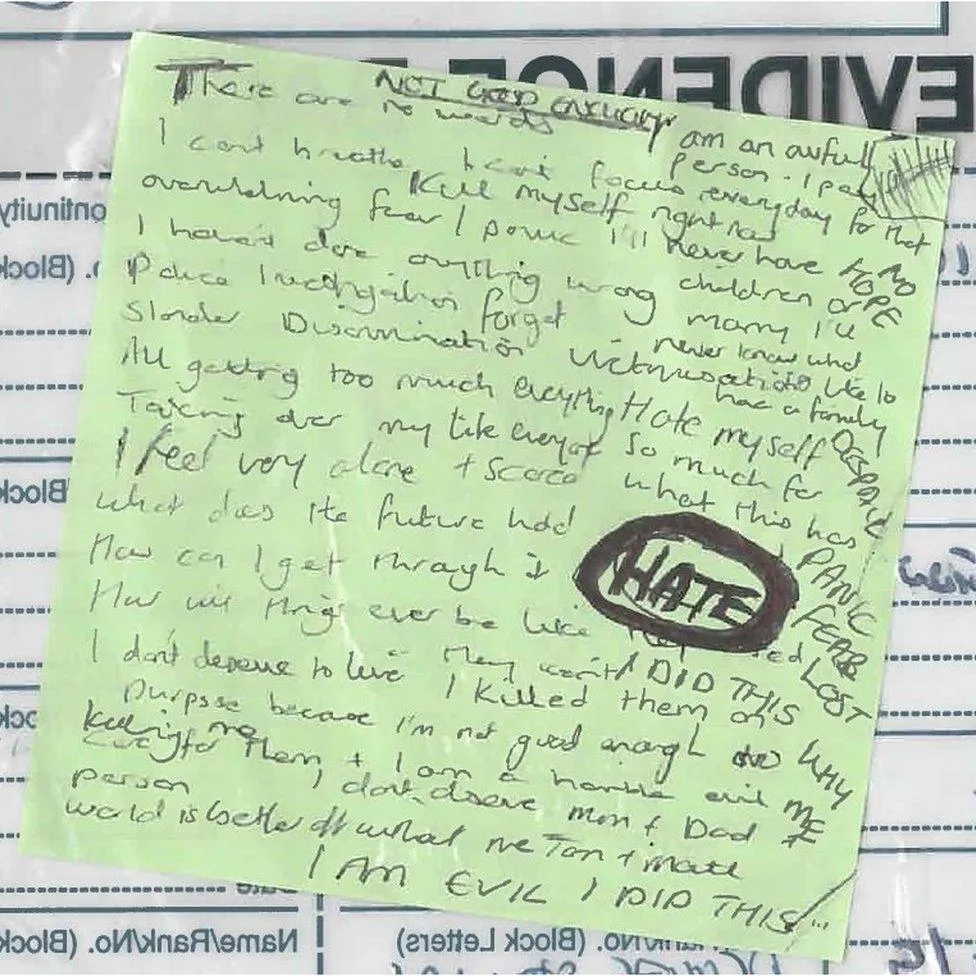
The infamous 'Green Note' presented as evidence by the prosecution in court.
1. The 'Green Note': Guilt vs. Imposter Syndrome
The green post-it note is the document most frequently cited as definitive proof of a criminal mind. However, a line-by-line textual breakdown reveals a duality that the prosecution deliberately glossed over during cross-examination.
"I haven't done anything wrong"
Hidden in plain sight on the exact same green note—and routinely cropped out of tabloid television broadcasts—is this clear, unequivocal statement of innocence. Why would a killer writing a secret, private confession explicitly write "I haven't done anything wrong"? On the same page, she writes of "Police Investigation slander Discrimination Victimisation". These are the spontaneous thoughts of someone who feels targeted, isolated, and falsely accused by hospital management, not an individual unburdening a guilty conscience.
"I killed them on purpose because I'm not good enough"
This sentence is central to understanding Letby's mental state. The phrase "because I'm not good enough" is the language of severe clinical inadequacy and toxic self-blame, not malice. Psychopaths and serial killers do not murder out of a feeling of clinical incompetence. This statement reflects severe Imposter Syndrome spiralling into catastrophic moral failure under intense stress.
In the high-pressure environment of neonatal intensive care, when a critically ill infant deteriorates, a highly conscientious, perfectionist nurse will often internalise the failure: Did I miss a symptom? Was I too slow reacting? Am I incompetent? To a traumatised, perfectionist mind, feeling professionally responsible for failing to save a life can become emotionally indistinguishable from taking that life.
"I'll never have children or marry"
Across the note, Letby writes "I'll never have children or marry" and "I'll never know what it's like to have a family". This is a classic grief response. Letby was processing the sudden, terrifying realization that the mere existence of a police investigation had permanently incinerated her career, her reputation, and her personal future, regardless of her actual guilt or innocence. She was mourning the death of her future self.
"I AM EVIL I DID THIS"
Written in heavy, scrawled ink, these words were framed by prosecutors as a literal confession. In forensic psychology, this phenomenon is widely recognised as an Internalised False Confession Internalised False Confession: A psychological state where an innocent person, under severe psychological stress, isolation, or persistent accusation, comes to genuinely believe or accept that they are responsible for a tragedy. . When an anxious, compliant individual is repeatedly told by authority figures, senior consultants, and hospital executives that deaths occurred because of her presence, the individual can internalise that blame. She was not stating a biological fact; she was adopting the monstrous persona projected onto her by the hospital management trying to cover up their own systemic failures.
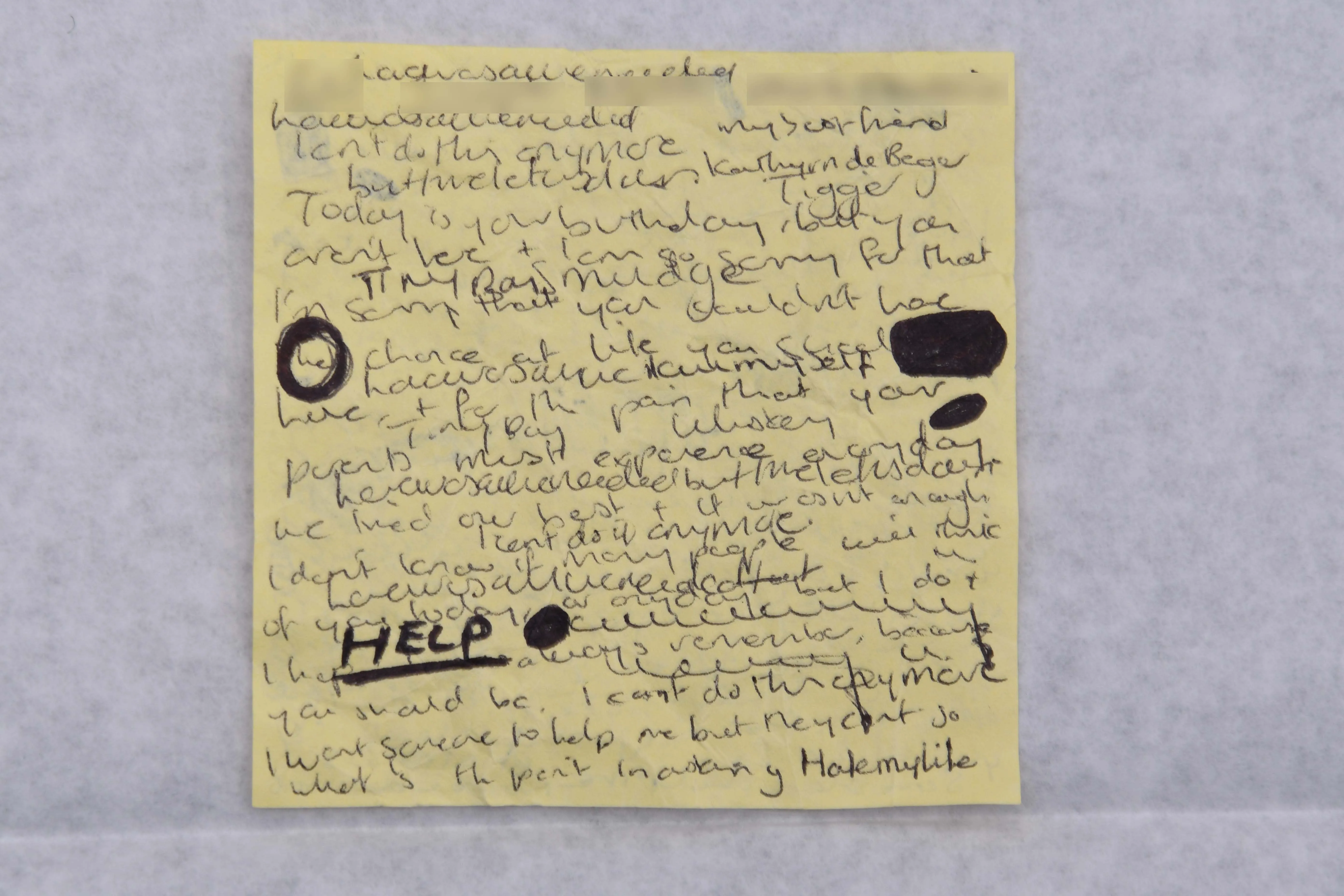
The 'Yellow Note' featuring a desperate cry for help and expressions of deep panic.
2. The 'Yellow Note': A Desperate Cry for Help
The second primary document recovered by investigators is even more indicative of an acute mental health crisis rather than a calculating criminal mastermind.
- "HELP": Written in bold, underlined capital letters, this is the central emotional theme of the yellow note. She scrawls, "I want someone to help me but they can't". This is an explicit, desperate plea for psychological intervention from an individual drowning in isolation.
- "Panic / Fear": These emotion words appear repeatedly across the margins. Panic, dread, and helplessness are the dominant themes—not satisfaction, dominance, or the callous detachment typical of healthcare serial killers.
- "I can't do this anymore": Repeated across multiple notes alongside the scribbled words "Kill myself", this points directly to severe suicidal ideation. Letby was seeking an escape from the unbearable psychological pressure of the accusations.
- Empathy for the Families: She scrawls, "Today is your birthday but you aren't here" and "I'm sorry that you couldn't have the chance at life you should have". These are expressions of profound sorrow and empathy for the deceased infants and their parents, contradicting the prosecution's claim that she possessed a cold, unfeeling nature. This is the overwhelming guilt of a caregiver who feels she failed in her primary duty to protect life.
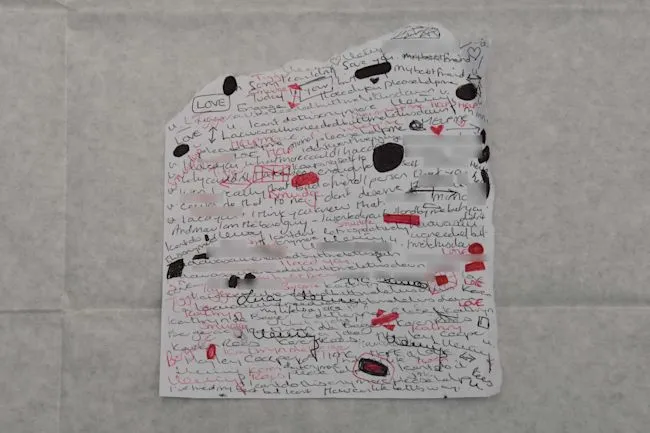
The chaotic scribbled note demonstrating severe psychological regression and panic.
3. The Scribbled Note: Regression and Cognitive Chaos
The frantic, overlapping scrawl featuring the names of her childhood pets ("Tigger" and "Smudge") alongside the repeated word "Love" indicates profound psychological regression Psychological Regression: An unconscious defence mechanism where an individual under unbearable stress mentally retreats to an earlier stage of development or seeks comfort in safe, childhood memories. . Under extreme, traumatic pressure, the human mind instinctively reaches for safe, unthreatening anchors from the past.
The physical nature of the handwriting—heavy pressure, overlapping text, and frantic scribbling out of words until the paper is torn—is a recognised clinical marker of acute anxiety, panic attacks, and severe cognitive overload. She repeats "Please help me" like a mantra. This is not a proud log of criminal achievements; it is the visual record of a complete nervous breakdown.
The Danger of Misinterpreting Trauma
In the UK legal system, introducing unstructured therapeutic or personal writing without proper psychiatric context poses a massive risk of miscarriage of justice. When a jury is presented with emotional scrawls without expert clinical context regarding how trauma presents in neurodivergent or highly anxious individuals, they are naturally inclined to take dramatic words literally.
Conclusion: Evidence of Trauma, Not Proof of Crime
When these handwritten notes are evaluated in their entirety rather than through cherry-picked sentences, they reveal a clear story. They do not document a serial killer confessing to horrific crimes. They record a young, isolated nurse enduring a total psychological breakdown, experiencing profound moral injury, and gaslit by a failing hospital system into internalising responsibility for tragic infant deaths.
She wrote "I haven't done anything wrong". It is time the criminal justice system gave that sentence the exact same weight as the rest.
Follow BRD Investigations as we continue to publish unredacted documents, expert psychological reviews, and independent forensic analysis into the Lucy Letby trial.


You people are a disgrace, think of the children’s families and you are doing this , just to make money from clicks . You are disgusting
ReplyDeleteThank you for your comment. We understand that this is an incredibly sensitive and emotional case, and our hearts go out to the families involved. However, seeking the truth is never a disgrace. If a miscarriage of justice has occurred—as the statistical and medical evidence suggests—then the families have been failed by the system just as much as the accused. Our goal isn't 'clicks'; it is to ensure that convictions are based on solid evidence, not coincidence or flaws. Justice requires the truth, no matter how uncomfortable it is to question the narrative.
Delete