Dr Dewi Evans: The Flawed History of the Letby Expert Witness
Examining the Flawed Testimony & Archival Record of Dr Dewi Evans
A History of Dismissed Claims: Why the Prosecution’s Star Witness Played the System
To truly understand the flawed medical narrative that led to the conviction of former neonatal nurse Lucy Letby, one must forensically examine the chief architect of that narrative: the prosecution's lead medical expert witness, Dr Dewi Evans. In complex, high-stakes medical trials, a lay jury relies heavily on the assumption that a court-appointed expert is an objective, detached scientist. However, an unredacted deep-dive into historical newspaper archives and Court of Appeal judgments reveals a deeply troubling pattern that provides the psychological key to his methodology.
By The BRD Investigations Team
In criminal proceedings where no direct physical evidence exists—no CCTV footage of an attack, no confession, and no eyewitnesses to a murder—the state relies entirely on circumstantial medical interpretation. In the case of Operation Hummingbird at the Countess of Chester Hospital, the prosecution built its entire framework upon the opinions of retired consultant paediatrician Dr Dewi Evans. Yet, when his professional record is subjected to independent scrutiny, the image of an infallible clinical authority rapidly dissolves.
1. The 1988 Morriston Hospital Controversy: A Lesson in Survival
Long before the tragic deaths at the Countess of Chester Hospital, Dr Evans found himself at the epicenter of another intense medical controversy. In February 1988, while working as a senior child specialist in South Wales, Dr Evans dropped what local newspapers described as a "bombshell" claim regarding Swansea's Morriston Hospital.
He publicly alleged that sick babies were dying on the neonatal unit specifically because the hospital was severely under-resourced and starved of specially trained nursing staff. At the time, Dr Evans appeared to be taking a courageous stand, attempting to sound the alarm on a failing, under-funded National Health Service (NHS) infrastructure.
However, the health establishment immediately closed ranks against him. His explosive public claims were swiftly and vehemently denied by the West Glamorgan Health Authority. Worse still for his professional standing, an official internal inquiry team was commissioned to investigate his allegations—and subsequently dismissed his claims entirely. He attempted to take on the NHS bureaucratic hierarchy, and he was publicly rejected, overruled, and humiliated.
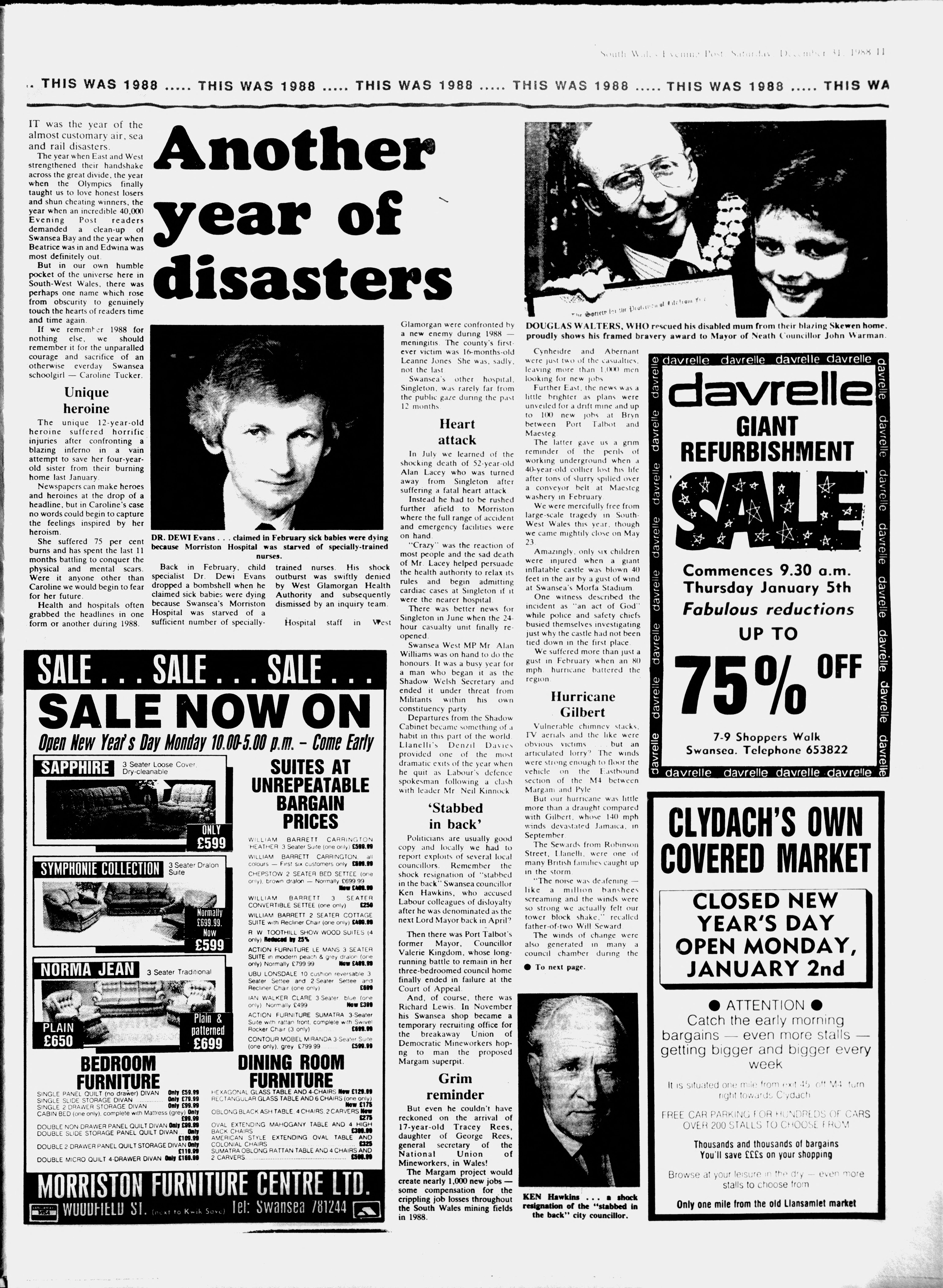
Hover over or tap the image above to dynamically zoom in and inspect the original 1988 archival report.
For an investigative journalist, this 1988 archival discovery serves as a vital piece of the puzzle. It demonstrates that Dr Evans is not merely an objective clinician, but a practitioner who learned a brutal lesson early in his career about institutional survival. It raises a profound psychological question: did his public defeat in the late 1980s condition him never to challenge the overarching NHS management structure again?
2. The Shift from Systemic Failure to Individual Scapegoating
Fast forward three decades to the Countess of Chester Hospital. It is a matter of public record that the neonatal unit where Lucy Letby worked was suffering from severe, dangerous systemic failings. Official reviews by the Royal College of Paediatrics and Child Health (RCPCH) documented that the ward was chronically understaffed, overwhelmed by an influx of highly premature infants, and plagued by shocking infrastructure failures, including raw sewage backing up into the hand-washing sinks in intensive care rooms.
When Dr Evans was brought in to review the cluster of tragic infant collapses, he was looking at a scenario eerily similar to Swansea in 1988: an under-resourced, failing NHS unit experiencing elevated mortality rates.
Except this time, Dr Evans did not point to the glaring systemic failures. He did not blame the hospital trust for starving the unit of resources or failing to maintain basic hygiene infrastructure. He knew from bitter experience that blaming an NHS Trust results in swift, aggressive institutional denials and official dismissal. Instead, the entire narrative of blame was pivoted onto the shoulders of a single, junior frontline nurse.
The Mechanics of Institutional Deflection
Rather than exposing a failing NHS Trust—a move that had backfired on him so publicly in 1988—assigning blame to a lone target provided a clean, convenient solution. This psychological pivot aligns perfectly with the clinical definition of Scapegoating Scapegoating: The practice of singling out a specific individual or group for unmerited blame and negative treatment, frequently utilised by large organisations to deflect attention away from systemic failures or corporate negligence. . Blaming an individual nurse neatly absolved the hospital executive management of corporate manslaughter, provided the police with a prime suspect, and secured the expert witness a celebrated role in a high-profile prosecution.
3. The 2022 "Worthless Evidence" Judicial Reprimand
Crucially, the 1988 inquiry is far from the only time Dr Evans' professional judgement has been formally rejected by official authorities. The pattern of his evidence being deemed unhelpful or unreliable continued right up to the eve of the Lucy Letby trial.
Just months before taking the stand in 2022 to give evidence that would help send Letby to prison for life, a senior Court of Appeal judge, Lord Justice Peter Jackson, heavily reprimanded Dr Evans in a separate, unrelated Family Court judgment (CS v Child and Family Court Advisory and Support Service [2022] EWHC 528).
The High Court judge threw out Dr Evans' expert report entirely, taking the extraordinary, highly unusual step of publicly branding his evidence as "worthless." Lord Justice Jackson stated in his written judgment:
"Dr Evans’ report falls far short of what is required of an expert witness... His opinion expressed in his report was worthless because it was based on an inaccurate understanding of the facts and an uncritical acceptance of the mother’s account... He allowed himself to act as an advocate rather than an independent expert."
When a senior appellate judge explicitly accuses a medical expert of acting as an "advocate" for one side rather than an objective scientist, it represents a catastrophic blow to their professional credibility. Yet, this damning judicial reprimand was never disclosed to the jury during the main Letby trial.
4. "Trawling" for a Role: How Dr Evans Embedded Himself
If Dr Evans’ history of dismissed claims and judicial reprimands were not enough to cast shadow on his testimony, the manner in which he initially became involved in the Lucy Letby investigation destroys the illusion of detached scientific objectivity entirely.
In a standard, unbiased medical-legal investigation, police authorities seek out the most relevant, actively practising clinical specialists and academic department heads to review medical records blindly. This did not happen in Operation Hummingbird.
During court proceedings, it emerged that Dr Evans actually pitched himself for the role. After seeing a television news broadcast reporting a suspicious spike in infant deaths at the Countess of Chester Hospital, he proactively wrote to the National Crime Agency (NCA) offering his services to assist the police.
In legal and investigative terminology, actively seeking out police work in this manner is referred to as "trawling."
Why is this detail so devastating to the integrity of the prosecution's case? Because it completely alters the psychological starting point of an expert witness. When an expert actively solicits a contract with law enforcement, their subconscious mindset shifts away from a neutral query ("What caused these deaths medically?") toward an investigative partnership ("How can I help the police build their case?").
This is the very definition of Investigative Bias Investigative Bias: A cognitive error where an investigator or expert witness becomes so aligned with law enforcement objectives that they unconsciously tailor their findings and hypotheses to secure a conviction, ignoring alternative explanations. . Dr Evans inserted himself into the police inquiry not merely to evaluate clinical pathology, but to formulate theories that would satisfy the police's working hypothesis. Given his documented history of suffering official pushback when blaming systemic NHS failures, providing the police with a neat, individualised theory of sabotage was the most logical route to professional prominence.
5. Conclusion: A System Protecting Itself
Lucy Letby is currently serving multiple whole-life tariffs based heavily on the medical theories of a retired doctor whose courtroom evidence has been branded "worthless" by senior appellate judges, whose early career claims were dismissed by official health inquiries, and who actively solicited the role of prosecuting her.
As international scientific consensus continues to challenge the validity of the medical claims made during the trial, the role of Dr Dewi Evans must be fully re-examined by the Criminal Cases Review Commission (CCRC) and the ongoing public inquiry. True justice is not achieved by accepting compromised expert testimony; it is achieved through unrelenting, transparent forensic scrutiny.
Follow BRD Investigations as we continue to publish unredacted documents, trial records, and independent forensic analysis on the British legal and health systems.


Comments
Post a Comment