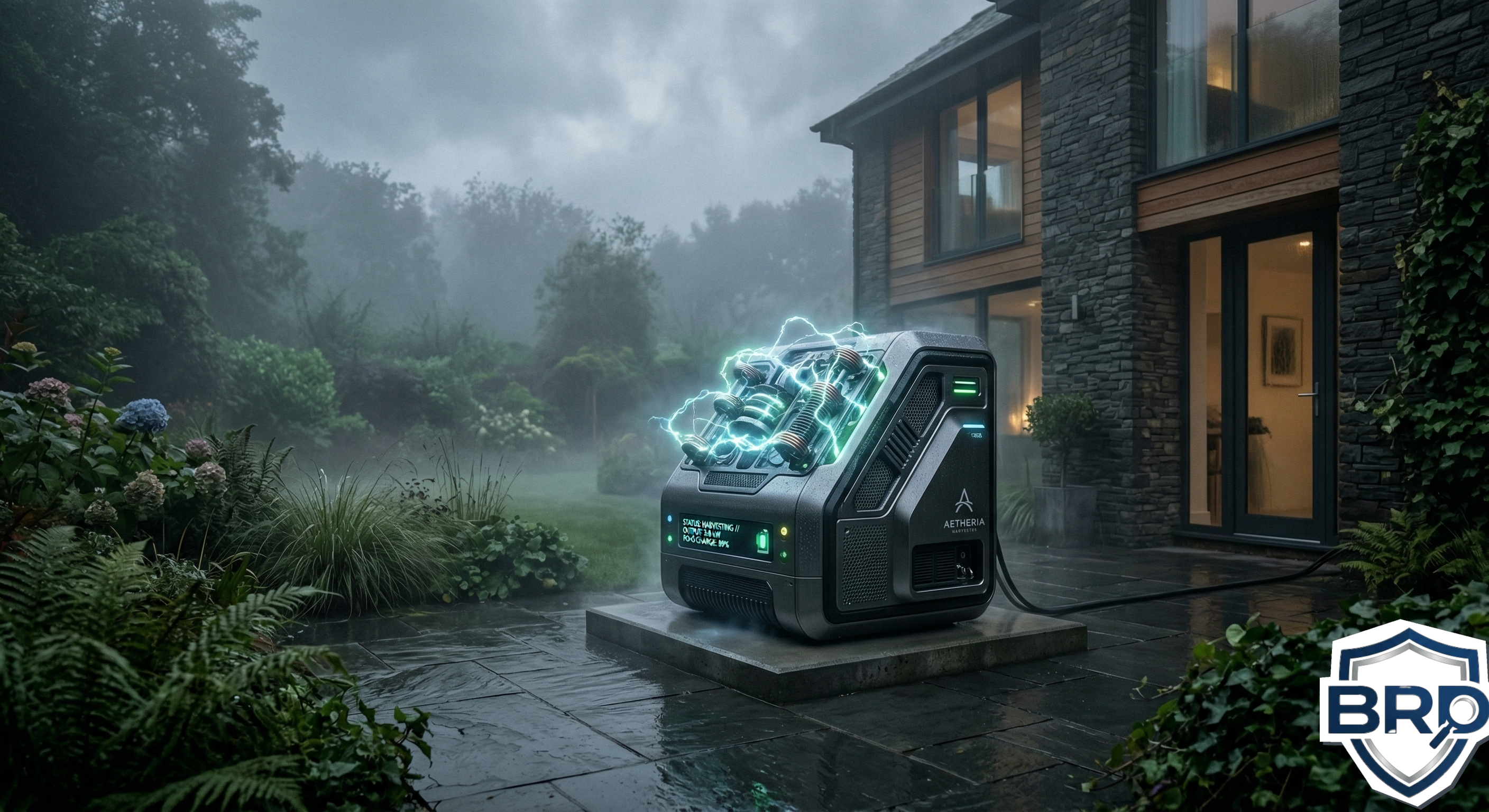
For decades, the United Kingdom has poured billions into offshore wind farms and solar arrays to secure a green energy future. However, a monumental scientific breakthrough known as hygroelectricityHygroelectricity: A type of static electricity generated by the natural movement and interaction of water vapour in the atmosphere. is turning a science-fiction concept into reality: generating continuous, abundant electricity directly from the damp British air.
By capturing the latent static electricity within atmospheric moisture, we can unlock an inexhaustible, clean power source. This is not just another green initiative; it is a fundamental shift in infrastructure that could ensure no one will ever need to rely on fossil fuels again.
The Science: Unlimited Electric from Thin Air
The mechanism powering this revolution relies on what physicists call the "generic Air-gen effect".
- The Nanopores: Scientists engineer materials to feature microscopic holes, or nanoporesNanopores: Extremely small holes or pores, strictly smaller than 100 nanometres in diameter, used to harvest electrical charge from moisture., that are strictly smaller than 100 nanometres.
- The Perpetual Charge: As naturally occurring water vapour drifts into these tiny pores, a dynamic adsorption-desorption exchange occurs at the porous interface. This constant interaction releases ions, creating a spontaneous and sustained electrical charging gradient.
The Miracle Material: Zirconium Oxide
While early laboratory tests used biological materials like protein nanowires, the commercial future of this technology lies in a vastly superior, industrial-grade alternative: zirconium oxideZirconium Oxide: A hard crystalline ceramic material, widely used in industry, that acts as a permanent converter to capture static electricity from water molecules..
Zirconium oxide is a hard crystalline ceramic material already widely used globally in everything from dental implants to the cladding for nuclear fuel rods. Crucially, this ceramic material never needs to be replaced to keep the power flowing.
The zirconium oxide does not act as a fuel that burns away; rather, it functions exactly like a solar panel, acting as a permanent converter that simply captures the static electricity from water molecules passing by. Because the atmosphere constantly replenishes its own moisture, the generator practically runs on an infinite loop. Once the device is built, the "fuel" is entirely free and limitless.
Scale and Output: Powering the UK Home
To understand how staggering this technology is, we must look at how it scales from a microscopic scale to power a modern household.
- The Individual Cell: In laboratory conditions with 50% humidity, a single zirconium oxide plate measuring just 8 by 5 centimetres can generate 0.9 volts of electricity.
- The Home Module: While one plate produces a modest amount of power, the European Union-funded CATCHER project is designing a system that stacks 20,000 of these cells together.
- The Footprint: This massive array can be packed into a compact conversion module roughly the size of a standard washing machine.
- The Output: That single, washing-machine-sized cube is projected to generate 10 kilowatt-hours (kWh) of electricity every single day.
Generating 10 kWh daily is enough to completely power an average UK household off the grid. It can comfortably run a large fridge-freezer, multiple washing machine cycles, an electric oven, lighting, and entertainment systems, whilst leaving a surplus to charge smart devices or a home battery unit.
Industrialisation: The Death of the Energy Bill
Currently, manufacturing these highly precise nanoporous ceramic plates carries a high "green premium," making early prototypes expensive to produce. However, the economics of scaling this technology mirror the early days of the microchip.
By building dedicated factories to automate and mass-produce these zirconium oxide cells, the manufacturing costs will plummet. The CATCHER project anticipates that through mass production, the Levelised Cost of ElectricityLevelised Cost of Electricity (LCOE): A measure of the average net present cost of electricity generation for a plant over its lifetime, used to compare different energy sources. (the average cost of power over the machine's lifetime) will drop to an astonishingly low 3 cents per kilowatt-hour.
At this price point, hygroelectricity completely undercuts traditional grid electricity and renders expensive, finite fossil fuels obsolete.
The Ultimate Investment
Unlike solar panels that sit idle under cloudy British skies, or wind turbines that stall on still days, these moisture generators provide a constant, unbreakable baseload of power. Energy companies and investors who back the mass industrialisation of zirconium oxide Air-gen modules today will position themselves at the forefront of the greatest energy transition in history. By turning the UK's famously damp weather into our greatest asset, we can finally close the chapter on fossil fuels forever.


Comments
Post a Comment