The March 2026 Dismissal of Scott Mills: Corporate Panic & Shifting Accountability
The abrupt and highly public termination of BBC Radio 2 presenter Scott Mills in late March 2026 stands as one of the most defining watershed moments in contemporary British broadcasting. After a highly lucrative and deeply embedded career spanning nearly three decades at the national broadcaster, Mills was summarily dismissed following an accelerated internal assessment of historical allegations concerning his personal conduct.
The suddenness of the departure—characterised by a seamless, jovial morning sign-off on the airwaves followed immediately by total institutional removal—has triggered profound industry analysis regarding the intersection of criminal law, employment contracts, and corporate reputation management.
Watch our deep-dive analysis on the BRD Investigations YouTube channel, and subscribe for more independent UK research.
The Historical Allegations and Police Probe
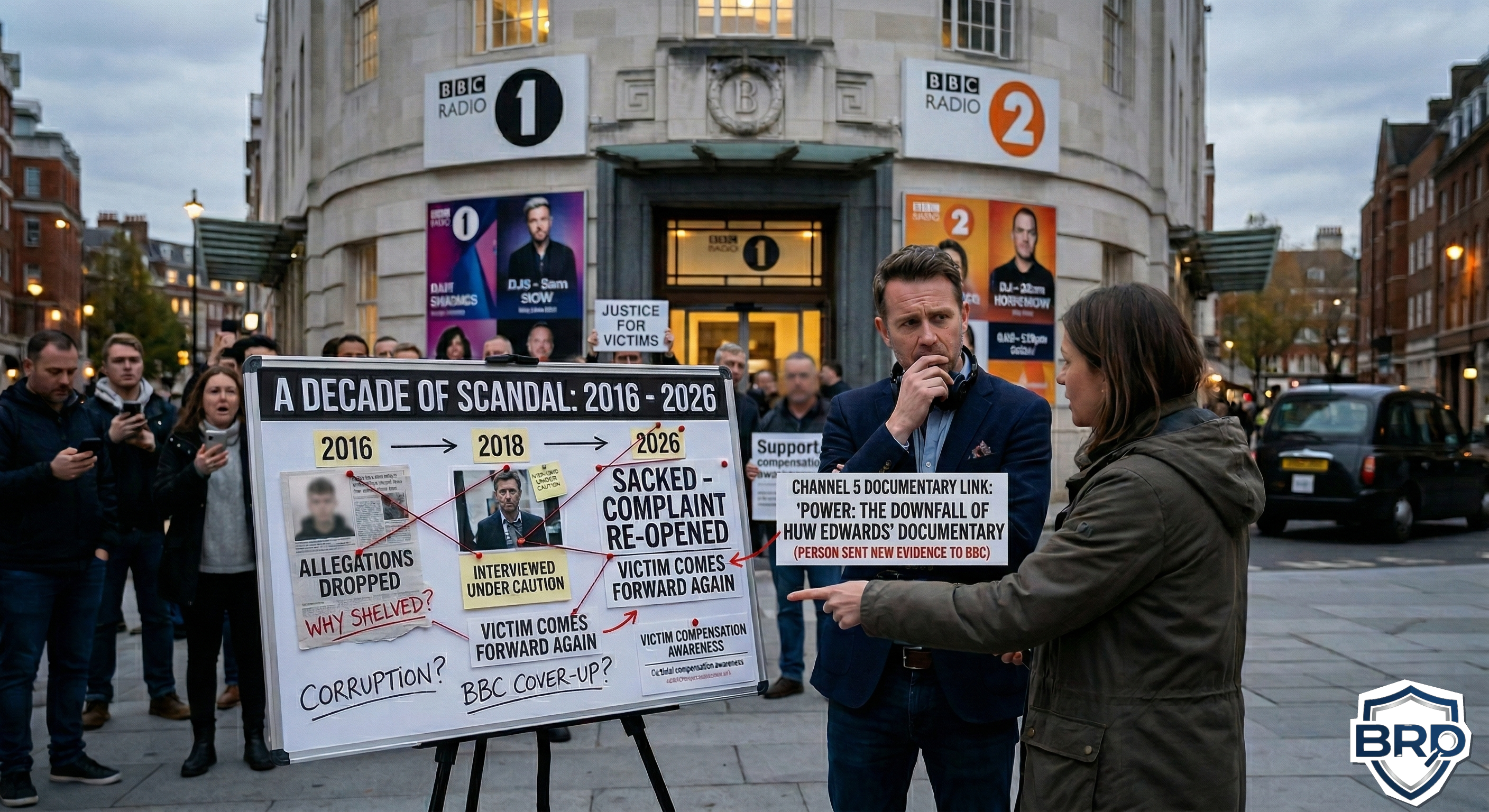
To understand the BBC's eventual actions, one must first dissect the rigorous, multi-year criminal investigation that preceded them. The allegations centre on "serious sexual offences" against a teenage boy, which were reported to have taken place between 1997 and 2000. The Metropolitan Police launched a formal inquiry in December 2016.
In July 2018, Mills was brought in and formally questioned by police under caution. However, in May 2019, after reviewing the submitted evidence file, the Crown Prosecution Service (CPS) determined that the case against Mills would be closed and no criminal charges would be brought. The CPS concluded that "the evidential threshold had not been met to bring charges". Consequently, the police investigation was permanently closed, and Mills retained his liberty with an unblemished criminal record.
The Cultural Catalyst: Huw Edwards
For nearly five years following the CPS's decision, the allegations remained dormant. The mechanism that finally fractured this stasis and triggered the corporate crisis was a profound cultural catalyst born from the broadcasting industry itself.
On Tuesday, 24 March 2026, Channel 5 broadcast the highly anticipated factual drama, Power: The Downfall of Huw Edwards to an audience of 1.5 million viewers. The drama was heavily billed as a forensic examination of the abuse of institutional power and predatory behaviour within national broadcasting corporations. The visceral portrayal of grooming and victim trauma acted as a profound societal catalyst. Realising the criminal justice route had been exhausted in 2019, the original complainant bypassed the police entirely and directed their evidence straight to the internal human resources apparatus of the BBC.
The Critical Timeline: March 2026
- Tuesday, 24 March (06:30 AM - 09:30 AM): Mills presents the BBC Radio 2 Breakfast Show as normal, engaging in standard light-hearted banter.
- Tuesday, 24 March (Daytime): The BBC officially receives a direct complaint regarding Mills's personal conduct. The BBC immediately activates its rapid-response internal assessment protocols; Mills is abruptly suspended.
- Tuesday, 24 March (09:00 PM): Channel 5 broadcasts the Huw Edwards drama, dominating the national conversation.
- Wed 25 - Fri 27 March: Veteran broadcaster Gary Davies unexpectedly opens the Breakfast Show, signalling a highly confidential HR blackout. The BBC conducts a hyper-accelerated internal assessment.
- Weekend of 28-29 March: The BBC's disciplinary unit concludes its review. Mills's contract for services is summarily terminated with immediate effect.
- Monday, 30 March: The Mirror publishes an exclusive exposé revealing the sacking and linking it to the 2016 Metropolitan Police investigation. At 12:00 PM, BBC Radio 2's noon news bulletin leads with the story.
The Paradigm Shift: Criminal vs. Corporate Law
The defining analytical question is how the broadcaster could be cleared by the CPS in 2019, yet face summary termination for the exact same underlying allegations in 2026. Resolving this paradox requires a forensic examination of the fundamental bifurcation between criminal law and United Kingdom employment law.
The CPS operates strictly within the criminal domain, where the standard of proof is beyond reasonable doubt Beyond Reasonable Doubt: The high standard of proof required in criminal proceedings. If a jury harbours any logical alternative explanation for the events in question, they are legally obligated to acquit. . In historical cases lacking forensic corroboration, achieving this standard is statistically improbable.
However, the BBC's internal assessment unit is governed by UK civil and employment law. In this arena, the standard of proof drops dramatically to the balance of probabilities Balance of Probabilities: The civil standard of proof requiring that a claim is more likely than not to be true (greater than 50% probability). . To take decisive disciplinary action, an employer merely needs to evaluate the available evidence and determine whether it is more likely than not that the misconduct took place.
High-net-worth broadcasting contracts universally contain highly restrictive morality and personal conduct clauses. The BBC merely needed to establish that the surfacing and validation of these severe allegations irreparably breached the implied duty of mutual trust and confidence. When an employee fundamentally breaches this trust, the employer is legally entitled to execute a summary dismissal Summary Dismissal: Termination of an employment contract with immediate effect. It is a severe mechanism generally reserved exclusively for acts classified as gross misconduct. .
The Scott Mills case confirms a harsh new reality for public figures in the contemporary media environment: the absence of formal criminal charges no longer guarantees employment immunity. Reputational liability, judged purely on the balance of probabilities within the confines of a corporate boardroom, is now sufficient grounds to instantaneously sever a three-decade career.


Comments
Post a Comment