A40 Over Bridge Roadworks Gloucester: The £12m Closure Costing You 166 Hours in Traffic
How Corporate Middlemen and the Tier 1 Framework are Profiteering from Gloucestershire's Gridlock
By BRD Investigations
Every month, the hardworking people of Gloucestershire pay their council tax. We pay it with the simple expectation that our local roads, bridges, and infrastructure will be maintained quickly, safely, and without wasting our money.
But what if the system wasn't designed to be quick or cost-effective? What if the very way our councils and highways agencies hand out contracts was purposefully built to funnel money from the public wallet into the pockets of massive corporate shareholders, whilst you are forced to set your alarm an hour earlier just to get to work on time?
Let’s pull back the curtain on how roadworks are really run, and why the impending nightmare on the A40 Over Bridge is a prime example of a fundamentally broken system.
The Commute Nightmare: A City-Wide Gridlock
Let’s talk about the reality of your morning drive. The average commute for a Gloucester worker is currently around 36 minutes each way. When the A40 Over Bridge refurbishment begins on June 8, 2026, you can wave goodbye to that.
The Over Bridge handles around 5,000 vehicles every single hour during peak times. It is the vital artery connecting the Forest of Dean and Highnam into Gloucester. The plan is to shut the slip road linking the A417 Over Causeway to the A40 westbound 24/7 for ten full months (until March 2027), alongside single-lane contraflows and a 30mph limit. Councillor Julia Gooch has already raised formal concerns about this "major disruption" preventing Forest residents from reaching vital medical appointments.
The Reality Check:
If you squeeze 5,000 cars an hour into a single-lane contraflow, the delay isn't just felt by people coming from the Forest of Dean. It causes a catastrophic ripple effect. When the A40 backs up, desperate drivers start rat-running. St Oswalds Road will jam. Westgate Street will crawl. Eastern Avenue and the Gloucester South West Bypass will grind to a halt.
Traffic experts estimate this kind of bottleneck will easily add 20 to 30 minutes to a journey. That turns a 36-minute commute into over an hour each way. That is an extra 50 minutes a day stuck in your car. Over the 10-month project, the average Gloucester commuter will spend an extra 166 hours sitting in traffic. People are fed up with having to leave home in the dark just to accommodate engineered corporate delays.
The Middleman Maze: How the "Tier 1 Framework" Costs You More
When Gloucestershire County Council or National Highways needs a road fixed, they do not directly hire the local builders, groundworkers, or concrete layers to do the job.
Instead, they use something called the Tier 1 Framework Tier 1 Framework: A system where massive corporate giants win lucrative government contracts, take a hefty management fee, and then subcontract the physical labour out to smaller companies, inflating the cost to the taxpayer. .
In the roadworks industry, this is known as "Margin on Margin." The taxpayer is forced to pay the massive corporate overheads of these giant companies, whilst the actual workers on the ground are squeezed on price.
Following the Money: Who Actually Gets Paid?
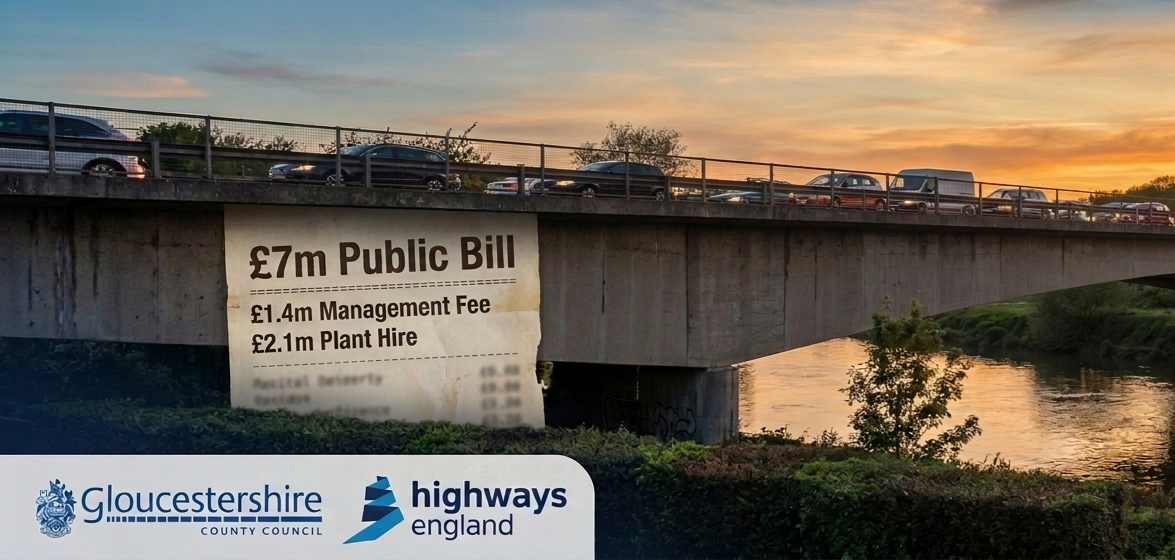
National Highways has quoted a budget of £7 million for the A40 Over Bridge. But where does that money actually go?
Because of the Tier 1 Middleman system, the local Gloucestershire contractors doing the actual heavy lifting see a fraction of it. Here is the realistic breakdown of how your money is carved up:
- Corporate Management Fees (approx 20%): £1.4 million vanishes straight into the pockets of the main corporate contractor just for "managing" the site.
- Plant and Cone Rentals (approx 30%): £2.1 million goes towards renting the temporary traffic lights, 24/7 CCTV, and miles of cones for ten months (often rented from sister companies owned by the same corporate giant).
- The Actual Workers (approx 50%): Only around £3.5 million is actually left to pay the local groundworkers, buy the concrete, and physically fix the bridge.
We are effectively paying £7 million for £3.5 million worth of actual work.
Local Comparisons: The True Cost of Overruns
If we look at local Gloucestershire projects, it becomes painfully obvious that the quoted £7 million budget is just a fantasy.
Look at the A417 Missing Link. Billed as a massive infrastructure upgrade, the costs have ballooned to an eye-watering £460 million. Look at the recent Llanthony Road widening scheme in Gloucester, which suffered from severe delays, spiralling material costs, and endless traffic misery.
The Tier 1 system allows massive companies to constantly claim for "compensation events" when they face winter weather delays. Because this 10-month A40 project runs right through the harsh winter of 2026/2027, the initial £7 million budget is practically guaranteed to overrun by 20% to 30%.
The Shocking Total:
When you add a conservative £2 million overrun to the initial £7 million budget, and then factor in the millions of pounds lost to the local Gloucester economy by tradespeople, delivery drivers, and commuters sitting idle in traffic for 166 extra hours... this "simple bridge repair" is realistically going to cost the region well over £12 million.
Slower is Better: Why Dragging It Out Pays
When you are sitting in A40 traffic, staring at a mile of traffic cones with absolutely no workers in sight, it is natural to get angry. But it is not the fault of the workers in the high-vis jackets. It is because the corporate system wants the project to take a long time.
If a giant company finishes a roadworks job in three months, they only get three months of money. But if they stretch it out to ten months, they hit the jackpot. They can charge the public wallet for ten continuous months of renting the temporary traffic lights and the site cabins.
When asked why they don't work 24/7 in shifts to get it done faster, the authorities claim that "due to staff working patterns, a 7-day schedule averages out to the same." This is an insult to our intelligence. In modern engineering, a 24/7 schedule is completely possible if you hire three different shift crews. But doing that means paying local workers premium wages for night shifts and weekends—and that would eat into the massive profit margins of the corporate bosses at the top.
The Simple Solution: Cut Out the Middleman
This engineered disruption does not have to be our reality. If Gloucestershire County Council and National Highways truly cared about the taxpayer, they would scrap these giant corporate frameworks tomorrow.
Instead of paying a massive middleman, the authorities should hire the local groundworkers, traffic management teams, and concrete specialists directly. By cutting out the giant corporations, they would instantly save millions of pounds.
They should use that saved money to pay local workers fantastic wages to work in round-the-clock, 24/7 shifts. If we put a fully funded, properly paid workforce on the A40 Over Bridge day and night, that agonising ten-month disruption could be finished in a matter of weeks.
It is time the people of Gloucestershire demanded better. We do not pay our taxes to fund the dividends of corporate shareholders while we sit in gridlock. We pay them to fix our roads—and we want them fixed now.


Comments
Post a Comment