The Highway Code Myth Catching Out Millions of UK Drivers: Did You Get It Right?
By BRD Investigations
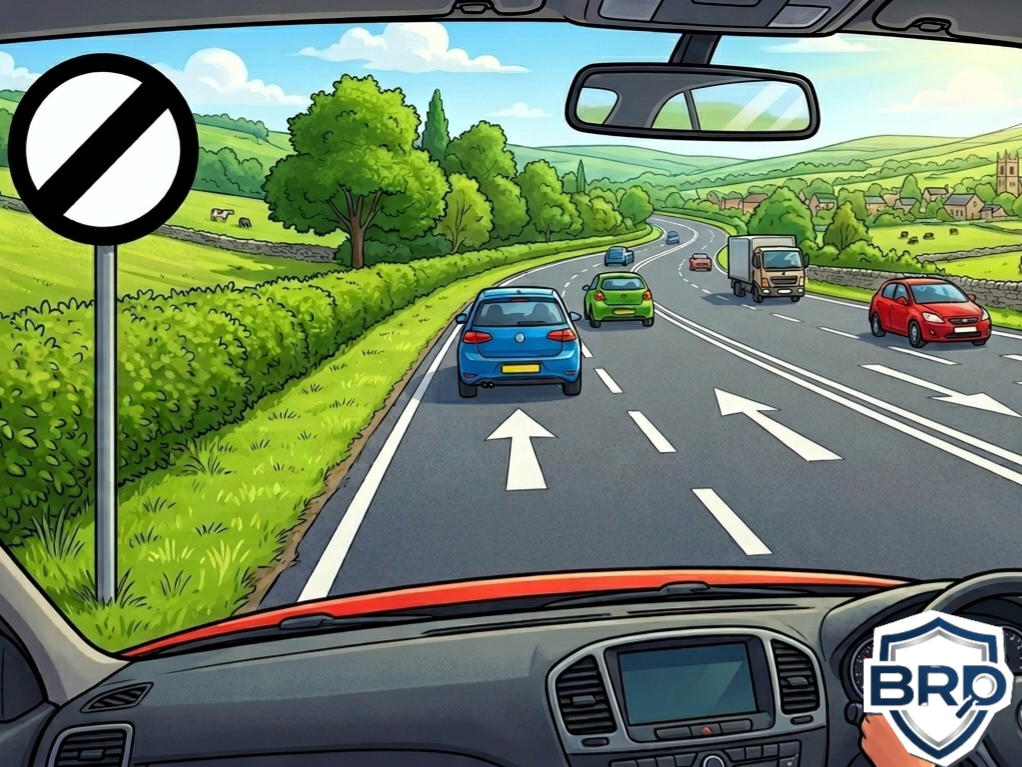
If you have clicked through from our recent social media poll, you are probably eager to find out if you got the right answer. You were presented with a scenario: you are driving a standard car on a road with a National Speed Limit sign. The road opens up into two wide lanes travelling in your direction, but there is no physical barrier separating you from the oncoming traffic.
Hold onto your answer for just a moment.
Whether you guessed 50 mph, 60 mph, or 70 mph, you are participating in one of the most widely debated and misunderstood aspects of UK driving. Millions of experienced, incredibly safe drivers are entirely unaware that their understanding of this specific road layout is flawed.
Before we reveal the correct speed, let's look at why this scenario is so confusing.
The Mental Shortcut We All Make
From the day we pass our practical driving tests, our brains start categorising the roads to make driving easier. We are taught that the National Speed Limit (the white circular sign with a black diagonal stripe) means 70 mph on a motorway or a dual carriageway.
Over time, drivers naturally start to build a visual shortcut. We begin to associate the visual of "two wide lanes" with the term "dual carriageway." After all, if there are two lanes going our way, it must be a dual carriageway, right?
Here is where the learning experience begins.
The Big Reveal: What is the Limit?
If you confidently answered 70 mph on our poll, you might want to brush up on your Highway Code.
The correct answer is 60 mph.
If you got it wrong, do not feel bad—you are in the vast majority. The reason it is 60 mph comes down to the legal definition of a dual carriageway, which actually has absolutely nothing to do with the number of lanes.
A dual carriageway is defined entirely by the presence of a physical central reservation—such as a metal crash barrier or a raised grass verge—separating the opposing flows of traffic.
If that physical barrier is missing, the road is legally classed as a single carriageway, even if it has two, three, or four lanes travelling in your direction. On a single carriageway, the National Speed Limit for a standard car drops instantly to 60 mph.
The Shocking Statistics
This misunderstanding is an epidemic on British roads. Fun fact: around a third to over half of UK drivers are confused by the rules or definition of a dual carriageway! Surveys reveal that 36% to 56% of motorists do not know the correct speed limits or fail to recognise signs indicating that a dual carriageway has ended.
The fundamental confusion usually stems from the difference between a single and dual carriageway, and the specific national speed limits applied to them. According to the Department for Transport’s (DfT) speed compliance statistics, roughly 1 in 10 drivers (up to 11%) consistently exceed the speed limit on National Speed Limit single carriageways.
When authorities analyse the speeds of drivers caught out on these specific 60 mph roads, there is a massive, unnatural spike right at the 70 mph mark. Drivers aren't recklessly putting their foot to the floor; they are actively and consciously aiming for 70 mph because they genuinely believe that is the legal limit. They are effectively setting their speed to break the law based on a deeply ingrained misconception.
Why Don't They Just Put Up a "60" Sign?
When drivers learn this rule, the first question they ask is usually: If the confusion is this widespread, why not just replace the confusing black-and-white diagonal sign with a standard, round "60" sign? Wouldn't that stop the confusion and save lives?
It seems like common sense, but doing so would actually create a much more dangerous situation.
The National Speed Limit sign is dynamic. It tells drivers that the default limit applies, but that default changes depending on the type of vehicle you are driving. On a single carriageway:
- Cars: 60 mph
- Vans (e.g., a standard Ford Transit): 50 mph
- Cars towing a caravan: 50 mph
- HGVs (over 7.5 tonnes): 50 mph
If local councils erected a rigid "60" sign, it would legally override those vehicle-specific limits. Suddenly, heavy articulated lorries and commercial transit vans would be legally permitted to do 60 mph on roads completely unsuited for their stopping distances. The National Speed Limit sign must stay in place to keep heavier vehicles in check, meaning car drivers must stay educated on the road layouts.
Conclusion: A Lesson for Every Driver
This scenario highlights exactly how human error works on modern roads. When drivers are navigating unfamiliar areas, managing hills, or dealing with everyday distractions, the brain naturally abandons critical scanning and relies entirely on visual shortcuts. We see multiple wide lanes and instinctively think "70," completely missing the absence of a central barrier.
This cognitive bias is similar to the Texas Sharpshooter fallacy Texas Sharpshooter Fallacy: A logical error where data is cherry-picked to fit a presumption. Like a gunman shooting at a barn and then painting a target around the bullet holes to claim he is a sharpshooter. , where a driver focuses only on the data that fits their presumption (two wide lanes) while ignoring the crucial missing context (no central reservation).
With the rollout of modern, stealthy digital radar cameras that do not require visible flashes or painted white road markings, thousands of motorists are learning this lesson the hard and expensive way via a fixed penalty notice in the post.
It serves as a powerful reminder for even the most veteran motorists: driving is an ongoing learning process, and we can never take road layouts for granted.
Have Your Say
Did this Highway Code rule catch you out on our poll? Have you ever found yourself assuming a wide road was a dual carriageway without checking for a central reservation?
Let us know your thoughts, and share your own learning experiences in the comments below!


Comments
Post a Comment