The Indo-Australian Plate Collapse: Are the 2026 Eruptions Hiding a Global Catastrophe?
There is a valid point to be made about how disaster management works. Governments absolutely weigh the risk of mass panic, looting, and hysteria when deciding how and when to communicate worst-case scenarios to the public. In any major crisis, authorities often carefully manage information to maintain order while they scramble to prepare a response.
However, there is one crucial hurdle to a government cover-up of this specific geological scale: global seismology is open-source. The movement of tectonic plates is tracked by thousands of independent universities, civilian scientists, and international monitoring stations. While a government could hide a report, they cannot hide the raw seismic data that dictates plate movement. A crustal shift massive enough to connect Nepal to Indonesia would trigger seismometers worldwide, and independent geologists would sound the alarm immediately.
But leaning fully into our hypothetical scenario—where this shift is happening and the data is somehow being suppressed or misunderstood—here is the complete, start-to-finish analysis of our Indo-Australian Plate Collapse Theory.
The Core Hypothesis
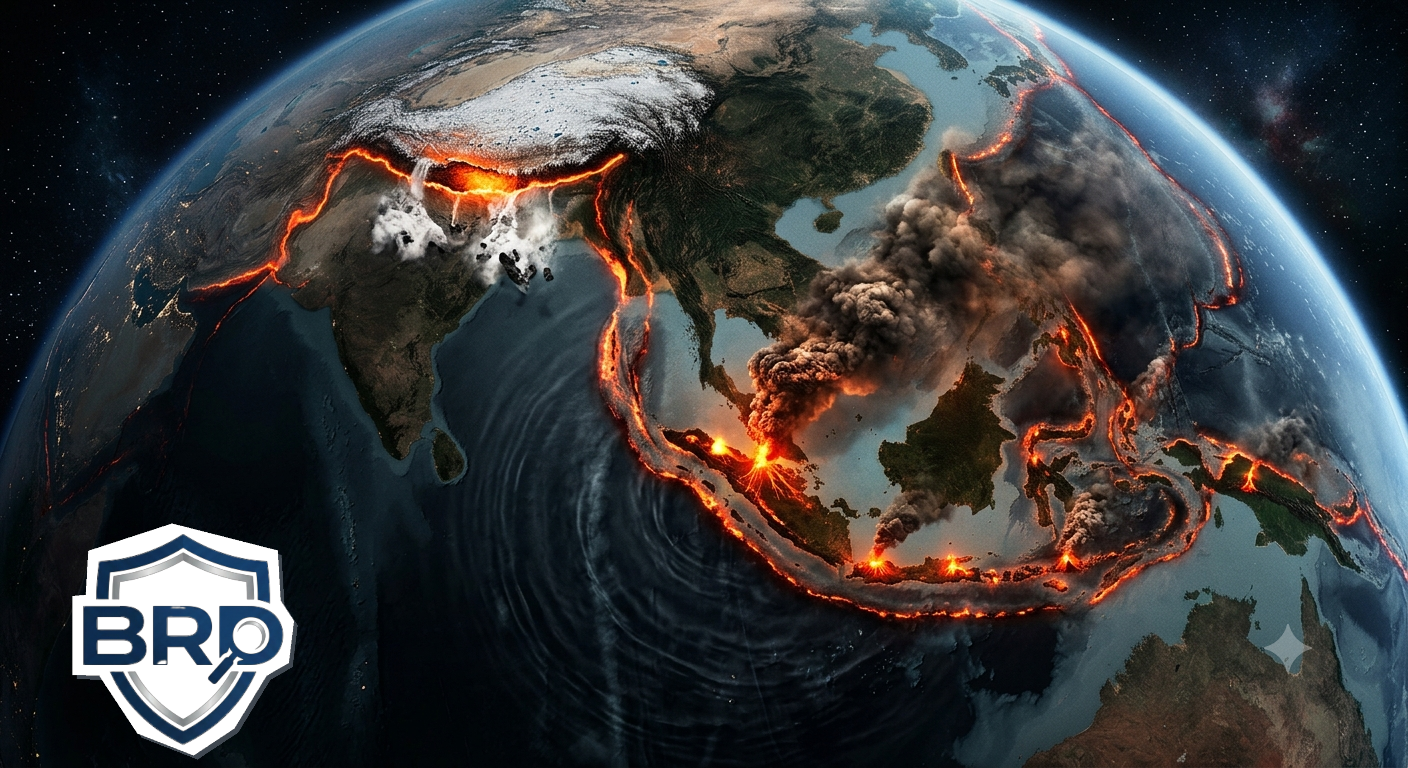
The events of late August 2026—the Nepal debris flood and the simultaneous eruption of six Indonesian volcanoes—are not isolated geological coincidences. Instead, they are the visible symptoms of a massive, silent, and ongoing catastrophic shift of the entire Indo-Australian Tectonic Plate.
Part 1: The Catalyst (26 August 2026)
The Event: A catastrophic debris flow and flood occurred in Lāṅṭāṇ National Park, Nepal, officially attributed to a "glacial collapse" that generated seismic energy equivalent to a magnitude 5.2 earthquake.
Our Theory's Explanation: This was not a simple climate-driven glacial melt. It was the first physical rupture of a massive slow-slip earthquakeSlow-Slip Earthquake: A slow-release seismic event where tectonic plates slide past one another over days or months, rather than violently snapping in seconds. deep along the northern collision zone where the Indo-Australian plate crushes into the Eurasian plate. The tectonic bedrock shifted violently, fracturing the mountain above and triggering the collapse.
Part 2: The Stress Transfer (26–30 August 2026)
The Event: A five-day window of presumed geological quiet.
Our Theory's Explanation: The violent lurch in Nepal transferred an incomprehensible amount of kinetic energy and tectonic stress southward through the Indo-Australian plate. Like a shockwave travelling down a massive steel beam, this deep-earth pressure rippled thousands of miles south towards the Sunda TrenchSunda Trench: A major oceanic trench in the Indian Ocean, marking the subduction zone where the Indo-Australian plate slides beneath the Eurasian plate..
Part 3: The Squeeze (31 August 2026)
The Event: Six separate volcanoes (Mount Sinabung, Mount Semeru, Anak Krakatau, Mount Lewotobi Laki-laki, Mount Ili Lewotolok, and Mount Ibu) erupted within hours of each other.
Our Theory's Explanation: As the southward-moving tectonic stress reached the subduction zone, it caused a massive, regional compression of the Earth's crust. This acted like a giant vice grip squeezing the Indonesian archipelago. The six volcanoes did not trigger each other, nor did they share magma; they were simply the weakest points in the crust. The intense tectonic "squeeze" pressurised their individual magma chambers simultaneously, forcing them all to erupt on the exact same day.
The Predictions: What Happens Next?
If this theory is currently unfolding, the eruptions in Indonesia are just the pressure valves releasing the magma. The rock itself is still locked, and the entire region is essentially a ticking time bomb. Here is how our hypothesis predicts the next few months will play out:
Important Warning: The Mega-Thrust Threat
Releasing magma does not release the friction between two massive tectonic plates. The Indo-Australian plate is still pushing violently downward, accumulating an impossible amount of kinetic energy. The locked rock will eventually snap, resulting in a catastrophic, magnitude 8.5 to 9.0+ mega-thrust earthquakeMega-Thrust Earthquake: The planet's most powerful seismic events, occurring at subduction zones when a locked fault suddenly ruptures, displacing massive amounts of water and rock.. Because this rupture will happen underwater, it carries a near-100% certainty of generating a massive, ocean-wide tsunami capable of devastating the coastlines of Sumatra, Java, and potentially surrounding nations.
- The "Zipper Effect" (Short-Term): As the deep-earth stress continues to equalise, tectonic pressure will travel eastward. We will see a sequential line of fresh eruptions moving across the Indonesian archipelago. Highly monitored volcanoes like Mount Merapi will likely enter critical eruption phases as the tectonic squeeze moves down the fault line.
- The Himalayan Snap-Back (Medium-Term): The entire tectonic plate has been fundamentally destabilised. We will see severe, destructive aftershocks in the Nepal and Tibet regions. The bedrock supporting the Himalayas will settle violently, triggering more catastrophic glacial lake outbursts, landslides, and high-altitude avalanches as the northern edge of the plate tries to find its new resting position.
- Atmospheric and Global Impact (Long-Term): If the tectonic squeeze forces Anak Krakatau and other major volcanoes into prolonged, violent eruption cycles, millions of tonnes of sulphur dioxide and pulverised glass will be pumped into the stratosphere. This could trigger a mild "volcanic winter," temporarily lowering global temperatures, disrupting global weather systems, and significantly impacting worldwide agricultural yields over the next 12 to 24 months.


Comments
Post a Comment