EXCLUSIVE: The "Law Enforcement" Secret – Why the Countess of Chester is Hiding the 2015 Pseudomonas Files
EXCLUSIVE: The "Law Enforcement" Secret – Why the Countess of Chester is Hiding the 2015 Pseudomonas Files
New documents reveal the Hospital Trust is withholding maintenance logs under "Law Enforcement" exemptions—hiding a bacterial crisis they knew about weeks before the first baby died.
By BRD Investigations
The Countess of Chester Hospital has refused to release maintenance logs regarding sewage back-ups and water contamination in its Neonatal Unit during the critical 2015-2016 period, citing an exemption usually reserved for protecting active police investigations.
In a response to a Freedom of Information request filed by BRD Investigations, the Trust confirmed it holds the data but refused to disclose it under Section 31 (Law Enforcement) of the Freedom of Information Act. This refusal is not just a bureaucratic denial; it is a tacit admission that the physical state of the hospital drains in 2015 is now considered material evidence in a criminal matter.
Why would plumbing records and water testing results from a decade ago be considered sensitive "law enforcement" data? The answer may lie in the hospital’s own internal documents, which reveal that management knew about a deadly bacterial risk in the water supply weeks before the first baby died—and actively chose to remove it from their risk register.
The "Law Enforcement" Shield
When we asked for "maintenance logs... relating to plumbing, drainage, sewage back-
ups, or water quality issues" and records of Pseudomonas aeruginosaPseudomonas aeruginosa: A deadly water-borne bacterium that thrives in hospital drains and sinks. It is known to cause fatal sepsis in premature babies and can mimic the signs of "sudden collapse" often attributed to other causes., the Trust blocked the request.
They stated: "The Trust considers that preventing prejudice to the ongoing investigation processes by the non-disclosure of such information outweighs the public interest in disclosure."
This implies that the physical state of the sinks and drains in 2015 is relevant to the ongoing legal battles surrounding Lucy Letby, including the Thirlwall Inquiry and potential corporate manslaughter charges. If the unit was biologically unsafe, the "spikes" in mortality may have a microbial explanation rather than a criminal one. By hiding this data, the Trust prevents independent experts from correlating "unexplained collapses" with documented plumbing failures.
The Smoking Gun: Risk 1220
While the Trust refuses to release the maintenance logs, internal documents obtained by BRD Investigations show that the hospital was fully aware of a water contamination crisis before the indictment period began.
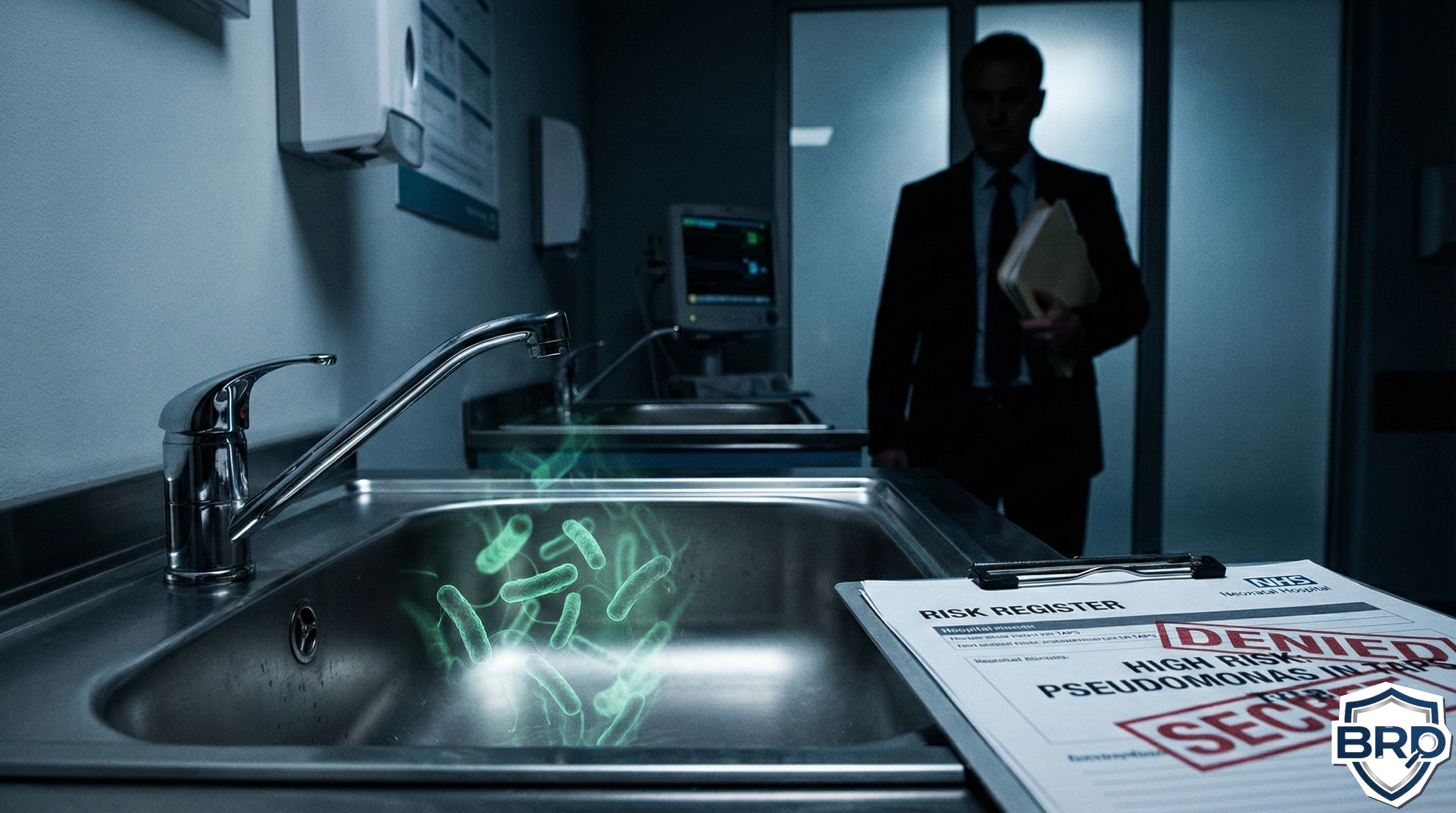
According to the Urgent Care Risk Register, a "High Risk" warning was formally logged on 20 May 2015—three weeks before the death of Baby A.
RISK ID: 1220
TITLE: PSEUDOMONAS IN TAPS
RISK LEVEL: High (Score 20)
DATE ADDED: 20/05/2015
HANDLER: Eirian Powell
This entry proves that the Neonatal Unit (NNU) was battling a known pathogen in its water supply at the very start of the alleged crime spree. Yet, rather than acting decisively, management appears to have engaged in a battle to suppress the concern.
The Boardroom Betrayal
The most shocking revelation comes from the minutes of the Paediatric Specialty Meeting held on 18 January 2016. At the height of the crisis, when babies were allegedly being attacked, the hospital’s Urgent Care Board actively rejected the NNU's attempts to flag safety risks.
The minutes state unequivocally:
"The Urgent Care Board rejected the addition of the risks highlighted by NNU of staffing issues, transport issue, pseudomonas and gas analyser without an explanation."
This is a damning piece of evidence. It shows that the clinical staff on the ground—led by Unit Manager Eirian Powell—were trying to escalate concerns about Pseudomonas and staffing levels, but the executive management board blocked these risks from the register "without an explanation".
It was only in the following month, February 2016, that Eirian Powell managed to force the issue back onto the table. The minutes from 15 February 2016 record:
"Eirian has reinstated the risks highlighted by NNU of staffing issues, transport issue, pseudomonas and gas analyser without an explanation."
This suggests a chaotic environment where safety warnings were being suppressed by upper management. If the Corporate ManslaughterCorporate Manslaughter: A criminal offence where a corporation or organization is found to have caused a person's death through a gross breach of duty of care, often due to systemic management failures. investigation is genuine, this specific refusal to acknowledge a "High Risk" pathogen must be central to it.
The Texas Sharpshooter Fallacy
The refusal to release the 2015 plumbing logs, combined with the evidence that management ignored Pseudomonas risks, suggests the prosecution of Lucy Letby may rely on the Texas Sharpshooter fallacyTexas Sharpshooter Fallacy: A logical error where data is cherry-picked to fit a presumption. Like a gunman shooting at a barn and then painting a target around the bullet holes to claim he is a sharpshooter..
This fallacy occurs when investigators focus on a cluster of data points (deaths) and draw a target around them (the nurse on duty), while ignoring the broader environmental context. If you investigate a cluster of deaths but suppress evidence of sewage back-ups and water-borne pathogens, you can easily make natural tragedies look like murder.
Connect the Dots:
- May 2015: Pseudomonas confirmed in taps. Risk level "High".
- June 2015: First death (Baby A).
- Jan 2016: Urgent Care Board rejects the Pseudomonas risk entry.
- July 2016: Police contacted (approximate timing of formal investigation launch).
- 2025: Trust refuses to release plumbing logs under "Law Enforcement" exemptions.
If the deaths were caused or exacerbated by a contaminated environment—a known issue with Pseudomonas, which can cause rapidly fatal sepsis and discolouration in neonates—then the hospital's failure to act in Jan 2016 isn't just negligence; it is the alternative explanation for the deaths.
What Are They Hiding?
We know from recent expert testimony that "poor plumbing and drainage resulting in sewage back-ups" was a known issue at the Countess of Chester. By using Section 31 to hide the proof, the Trust is effectively admitting that the state of the building is relevant to the criminal case.
The Freedom of Information Act exists to ensure transparency. When a public body claims that revealing the maintenance history of a sink is a danger to "the administration of justice," we must ask: whose justice? The justice of a fair trial, or the justice of a hospital reputation?
BRD Investigations has filed an immediate appeal against this refusal. The public deserves to know: was the Neonatal Unit safe, or was it a biological time bomb?


Omg It’s so clear that sepsis was such a big factor with the babies deaths and they suppress this information
ReplyDeleteGrow up.
ReplyDelete